☯ Concept Cartoons ☯
Table of Contents
1 Chemistry Metals and Ores 8 - Where do metals come from?
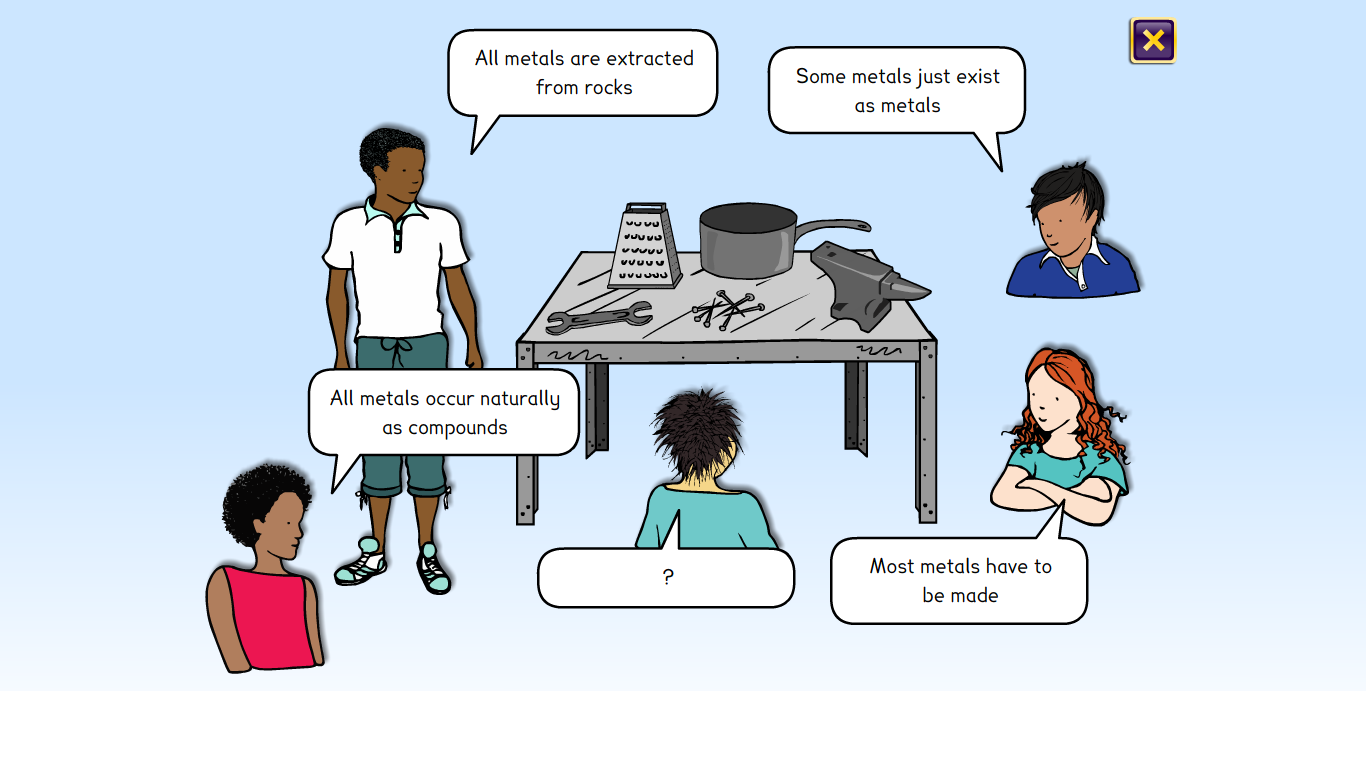
Have you talked about your ideas? Do you agree with any of the characters or do you think something different? Do you all have the same ideas? Here are some ways of finding out more. Make a list of common metals in your home. Use a textbook or the internet to find out where these metals come from. How many metals can you name? Most people can name around 10, but there are lots more! Use a periodic table to identify metals that you do not already know. Find out what arrangements your town has for recycling metals. Why do you think recycling of metals is important?
Here’s what a scientist might say. Did you find any evidence to support or justify these ideas? Are there any questions that you still need to answer? The word metal comes from the Greek word ‘métallon’, which means mine, quarry and metal. This suggests where most metals come from. Most metals are found in the Earth’s crust. Some metals are very unreactive and can be found as pure metals. Gold is one example. People discovered and used gold more than 7 000 years ago. Most metals are more reactive than gold, and these are found in the Earth’s crust as compounds called ores. The metal ores have to be mined and processed to extract the metal. If the metal is very reactive, it requires a lot of energy to extract it from its ore. Metals can also be recycled from objects made of, or containing, metals. Usually this requires less energy than extracting metals from their ores. Metals are not made. They are already present on Earth, even if extracting them from their ores can be difficult. Metals have been very important in human history. Create a table to show how different metals and their properties have influenced human civilisation over the past 5 000 years.