☯ Concept Cartoons ☯
Table of Contents
1 Chemistry Periodic Table 9 - How is the periodic table arranged?
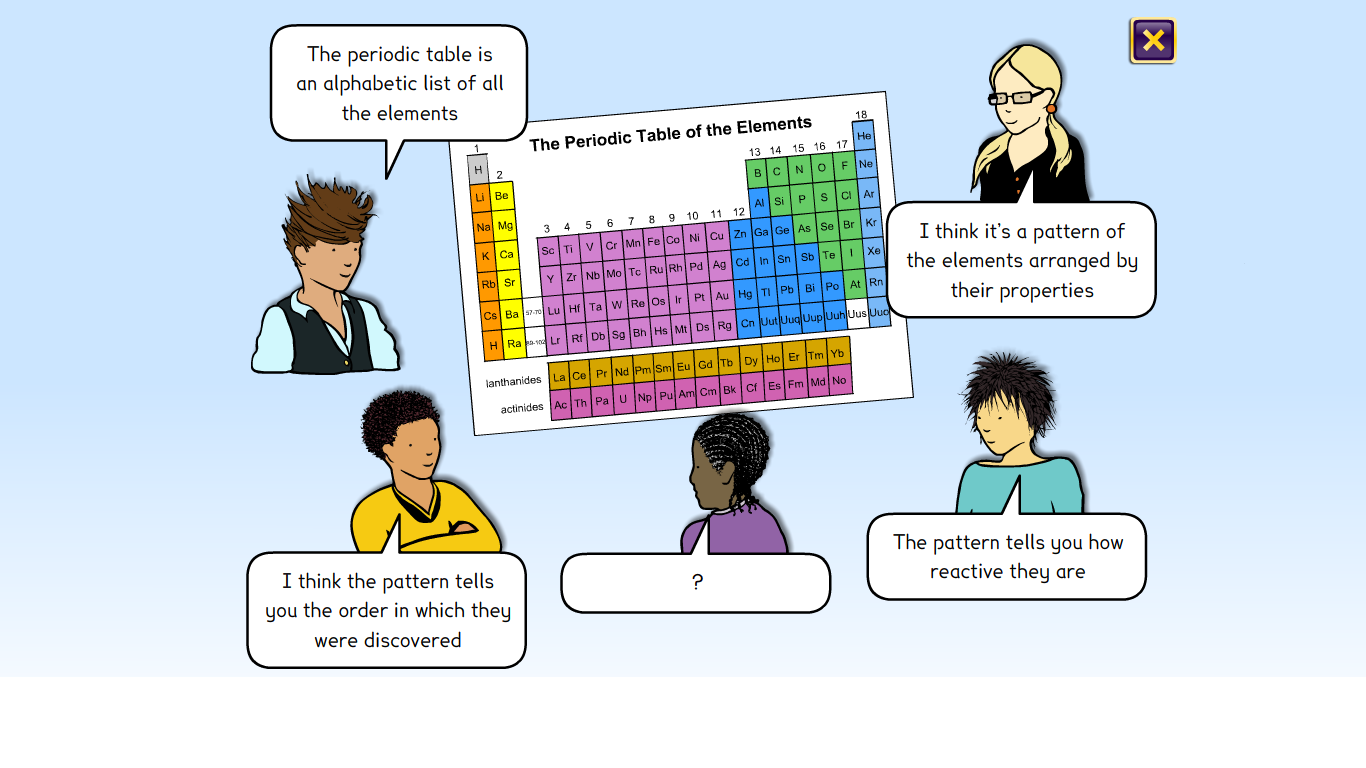
Have you talked about your ideas? Do you agree with any of the characters or do you think something different? Do you all have the same ideas? Here are some ways of finding out more. Look closely at a periodic table. Find the numbers in the corner of the element boxes. Look for any patterns in the numbering, and talk about any patterns you can spot. Find out about the history of the periodic table. Who was the first to produce one, and who created the one that we use today?
Here’s what a scientist might say. Did you find any evidence to support or justify these ideas? Are there any questions that you still need to answer? In 1869 a Russian chemist called Dmitri Mendeleev was the first scientist to create a periodic table like the one we use today. He tried to organise the elements that had already been discovered in order of the mass of each atom (the atomic mass). He realised that some elements shared similar properties, and he arranged the elements with similar properties in columns. He also predicted that not all the elements had been found, so he left gaps and predicted what properties the ‘new’ elements would have. As more elements were discovered his predictions were proved correct. Other scientists have used the periodic table to develop models to explain the structure of each element. They have identified the arrangement of neutrons, protons and electrons in each element to explain how they behave. Today the elements are arranged in the sequence of their atomic numbers, not their atomic mass. What is the difference between atomic number and atomic mass? Choose five elements from different parts of the periodic table, and try to explain how their atomic number and atomic mass affect the behaviour of each element.