☯ Concept Cartoons ☯
Table of Contents
1 Chemistry Quantitative Chemistry 10 - Numbers in equations
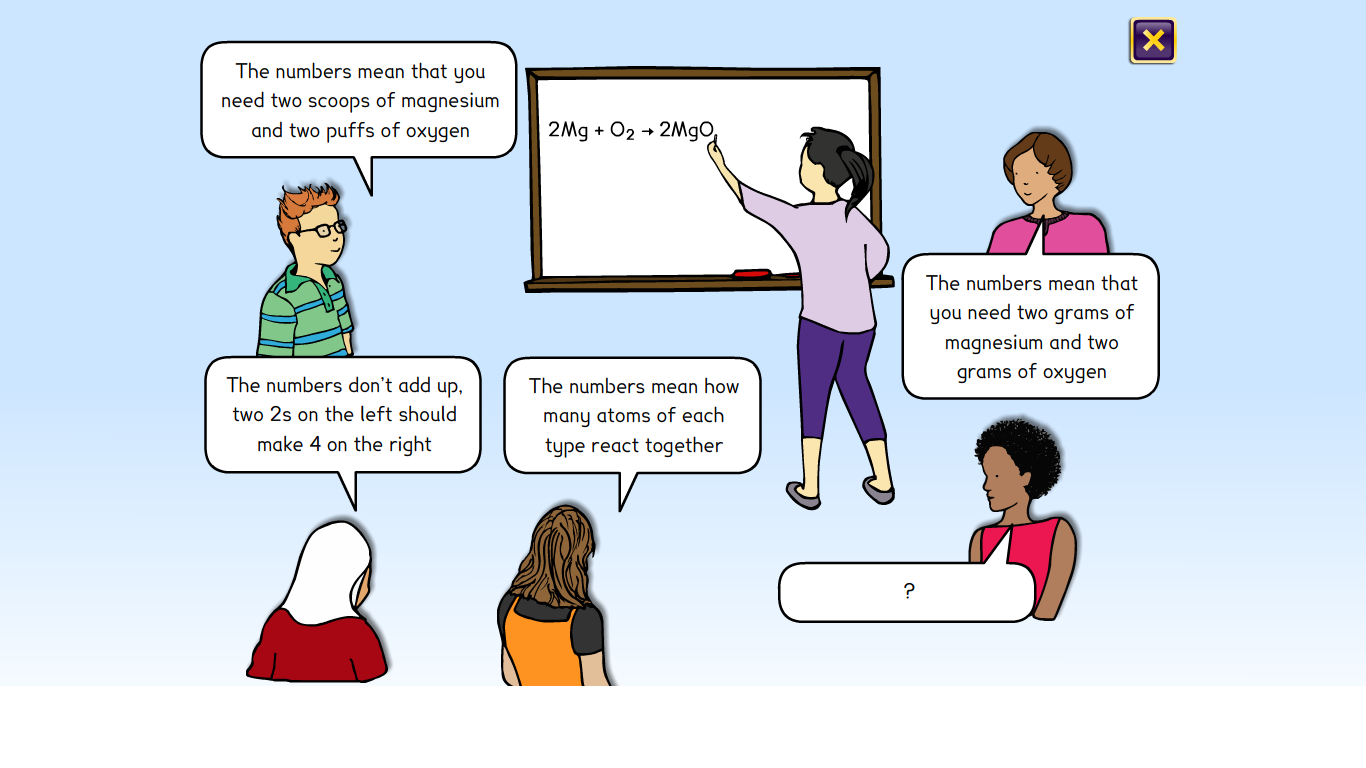
Have you talked about your ideas? Do you agree with any of the characters or do you think something different? Do you all have the same ideas? Here are some ways of finding out more. Look up some equations in chemistry textbooks or on the internet. Talk about what the numbers in the equations might mean. Use the periodic table to help you. Use a book or the internet to check what the symbols and numbers represent. How do you think scientists know how many atoms there are in a reaction when atoms are much too small to be seen?
Here’s what a scientist might say. Did you find any evidence to support or justify these ideas? Are there any questions that you still need to answer? Elements are the atoms that join together to make more complicated molecules. They are listed in the periodic table. Because of the way the electrons in each atom are arranged, atoms only combine in certain ways. For example, every water molecule is a combination of two hydrogen atoms and one oxygen atom, giving it a formula H2O. When magnesium burns it makes magnesium oxide. Each atom of magnesium combines with one atom of oxygen to make magnesium oxide, MgO. Correctly written chemical equations must balance, with the same numbers of each atom on each side. Oxygen in the air is a molecule made from two oxygen atoms joined together, with a formula O2. Because oxygen is always found as O2 we have to show that one molecule (two atoms) of oxygen reacts with two atoms of magnesium to make two molecules of magnesium oxide. The small numbers show the number of atoms in each molecule, and the large numbers show how many molecules there are. Make some models or pictures of the atoms to explain the equation to someone else.