☯ Concept Cartoons ☯
Table of Contents
1 Chemistry Quantitative Chemistry 9 - Magnesium burning
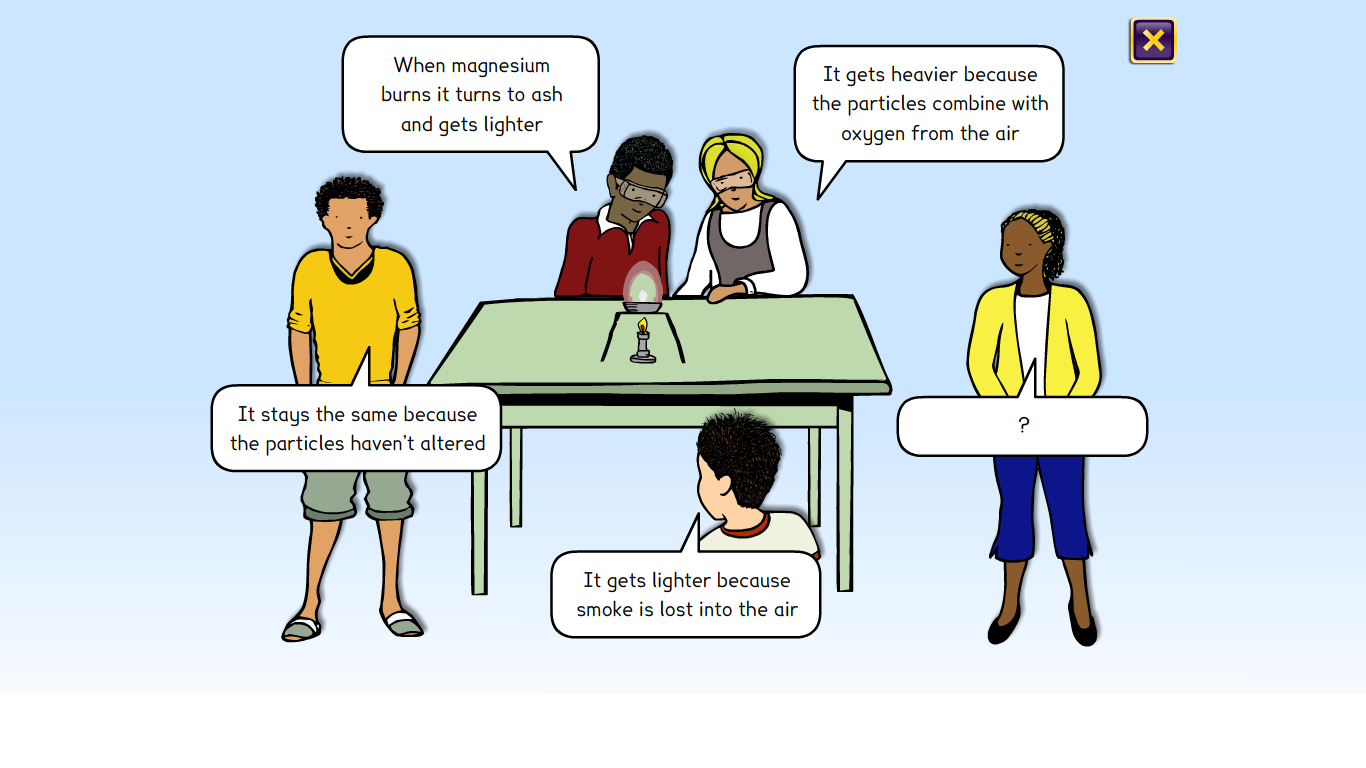
Have you talked about your ideas? Do you agree with any of the characters or do you think something different? Do you all have the same ideas? Here are some ways of finding out more. You can’t easily burn your own pieces of magnesium to test this, unless you are in a laboratory. Iron wool is easier and safer to burn. Try burning a small piece of iron wool, making sure you do this safely. Talk about what you see happening and whether you think the iron wool gets heavier or lighter. Weigh it and check what has happened. Talk about whether any gases or smoke might be lost in burning and whether you can collect and weigh these. Would it be possible for something to completely disappear when it burns? Safety note: Burning iron wool can get very hot and you might burn yourself or possibly scorch or set fire to something. Make sure you are supervised by an adult and put the iron wool on a flame-proof surface and take care with the lighter or matches you use to set it alight.
Here’s what a scientist might say. Did you find any evidence to support or justify these ideas? Are there any questions that you still need to answer? When magnesium burns it combines with oxygen from the air and makes a new substance called magnesium oxide. All the magnesium particles are still there, but each has been joined to an oxygen particle, so together they weigh more than the magnesium on its own. A chemical reaction takes place in which one set of substances, called the reactants, changes into new substances called the products. It is possible to do this in a laboratory, making sure that none of the magnesium oxide is lost, and show that it gets heavier. Some very reactive metals form oxides without having to be burnt. They just react with oxygen from the air. What advice would you give to a jewellery designer about which are the best metals to use, which metals would not be suitable, and why?