☯ Concept Cartoons ☯
Table of Contents
1 Chemistry Thermochemistry 12 - Exothermic/endothermic reactions
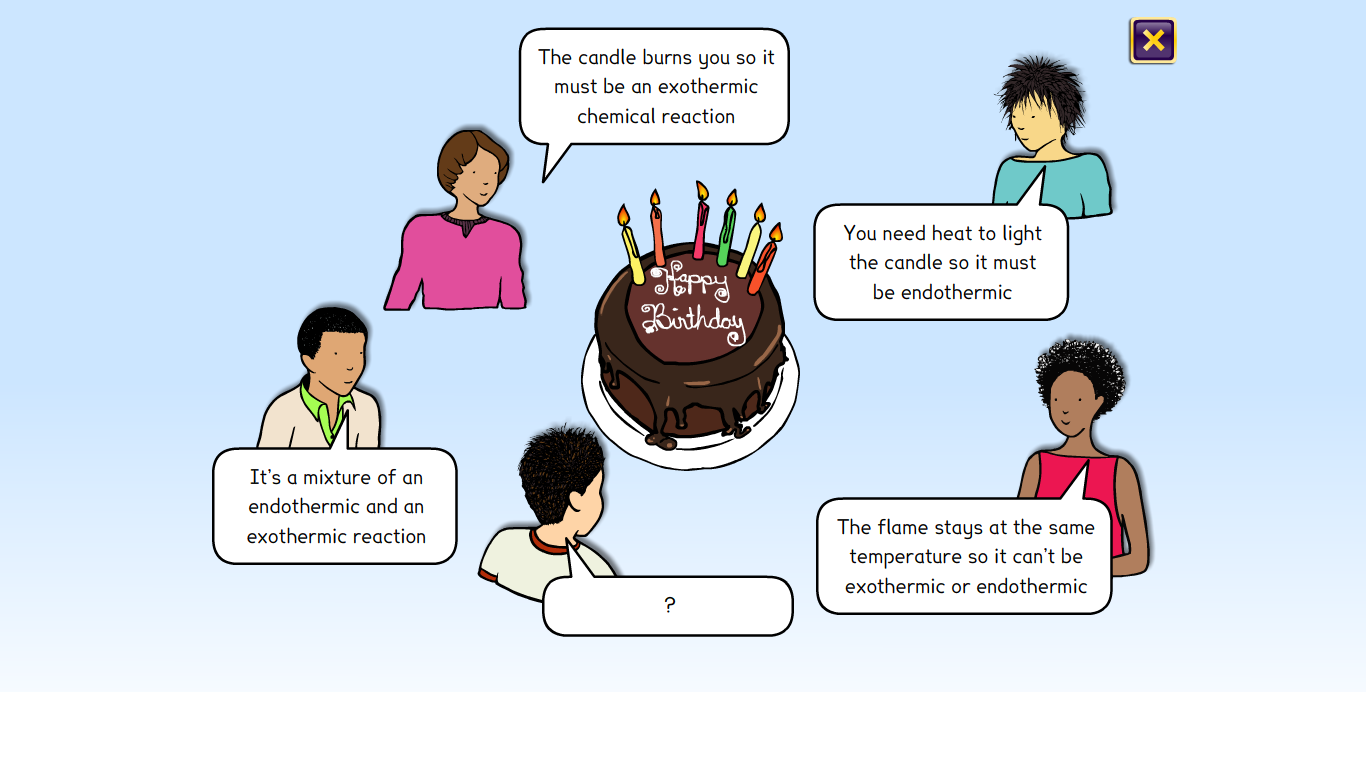
Have you talked about your ideas? Do you agree with any of the characters or do you think something different? Do you all have the same ideas? Here are some ways of finding out more. Light a small candle and watch it burn. Concentrate on the flame. Talk about what is happening in terms of energy transfer – what changes are taking place, how does the flame carry on burning, where does the energy come from and where does it end up? How can you tell if a chemical reaction is happening? Look this up in a book or on the internet if you are not sure. Safety note: A candle flame is very hot and you could burn yourself or possibly scorch or set fire to something. Make sure you are supervised by an adult, that the candle is securely on a flame-proof surface and cannot fall over. Take care with the lighter or matches you use to light it.
Here’s what a scientist might say. Did you find any evidence to support or justify these ideas? Are there any questions that you still need to answer? In a chemical reaction, some bonds between atoms and molecules are broken and new bonds are formed. Energy is needed to break the bonds and start the chemical reaction. This is called the activation energy. Sometimes the activation energy is so low that the reaction starts spontaneously. This is because the energy of the particles colliding is enough to start the reaction. Once it starts, burning is an exothermic reaction. This means that energy is transferred to the surroundings. The flame burns at a fairly constant temperature and transfers energy to the surroundings. Some reactions are endothermic, which means they need to absorb energy to happen. These reactions often need to be heated to work, and they make the surroundings colder. Making an omelette from raw eggs is an endothermic reaction. You have to put in energy to make this reaction happen. Can you make a list of what you think are the five most important exothermic and endothermic reactions that affect your everyday life? Does everyone agree?