


A motorist wishes to travel 40 kilometers at an average speed of 40 km per hour. During the first 20 kilometers, an average speed of 40 km/h is maintained. During the next 10 kilometers, however, the motorist goofs off and averages only 20 km/h. To drive the last 10 kilometers and average 40 km/h, the motorist must drive
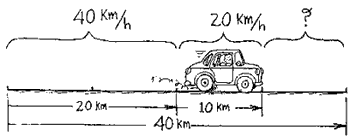
You would have to travel at an infinite speed and finish the last 10 kilometers in zero time to attain an average speed of 40 km/h! Why? Because you have one hour to make the trip, and your one hour is up at the 30-kilometer point. You spent 1/2 hour getting to the half-way point (20 kilometers) and another 1/2 hour when you averaged 20 km/h over that 10-kilometer stretch. So you'd have to cover the entire 40 kilometers in one hour—that means, the last kilometers must be driven in no time at all!
About
Science
I
Mechanics | II
Properties of Matter | III Heat | IV Sound &
Light
V
Electricity & Magnetism | VI Atomic &
Nuclear Physics
Next-Time Question
| Questions &
Answers with Paul Hewitt | cpSURF Home Page
