Ammonia: introduction
 Ammonia,
formula NH3, is a gas at room temperature. It has a pungent smell of
'wet nappies' - this is because urine can decompose to ammonia. A solution of
ammonia is alkaline, and you might find one in the kitchen cupboard for use as a
cleaner, because it will dissolve grease. Most of the ammonia manufactured is
converted into fertilizers like ammonium nitrate - trade name NITRAM - or ammonium
sulfate. These provide nitrogen to the soil.
Ammonia,
formula NH3, is a gas at room temperature. It has a pungent smell of
'wet nappies' - this is because urine can decompose to ammonia. A solution of
ammonia is alkaline, and you might find one in the kitchen cupboard for use as a
cleaner, because it will dissolve grease. Most of the ammonia manufactured is
converted into fertilizers like ammonium nitrate - trade name NITRAM - or ammonium
sulfate. These provide nitrogen to the soil.
Some background
The Haber Process for manufacturing ammonia, was discovered and developed by
Fritz Haber and Carl Bosch in Germany in the early 20th century. This was
timely, because during the First World War, the British navy blockaded the
import of nitrates from Chile, which at that time were used to make ammonia for
explosives. Ammonia from the Haber Process was used to make nitric acid and the
production of explosives went ahead. (Haber won the 1918 Nobel Prize for this
process - a number of French scientists refused their awards because of Haber's
war work for Germany.)
Ammonia: fact file
| World production |
140 million tonnes per year |
| UK production |
1.3 million tonnes per year |
| Manufacture |
Haber process |
| Raw material |
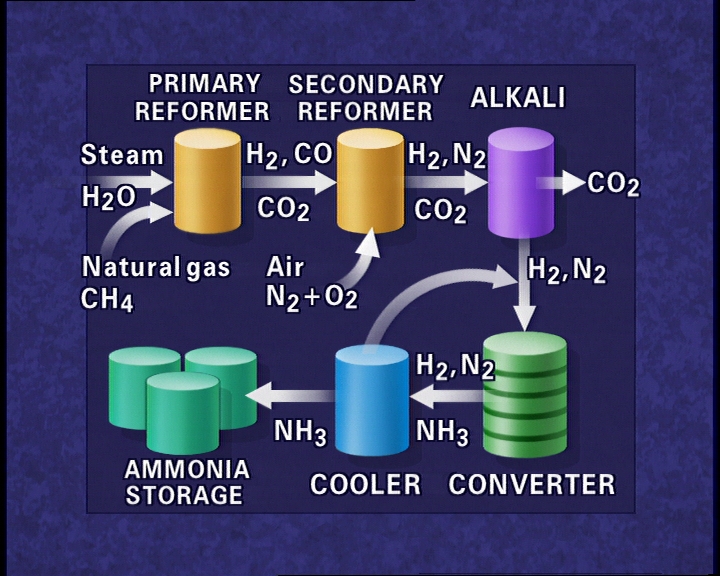
Natural gas (methane), water, air |
 |
Making fertilizers |
80% |
 |
Making other chemicals and wool pulp |
8% |
 |
Making Nylon |
7% |
 |
Making nitric acid |
5% |
 |
 |
| Map |
Aerial view of plant |
 |
 |
| Unlabelled process diagram |
Labelled process diagram |
 |
 |
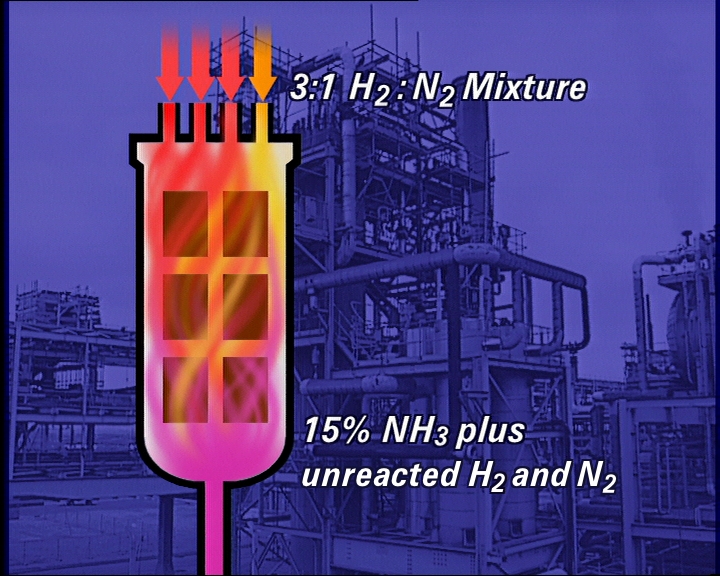
| Unlabelled diagram of the converter |
Labelled diagram of the converter |
Ammonia: on the web
last update March 2006