Iron and steel: introduction
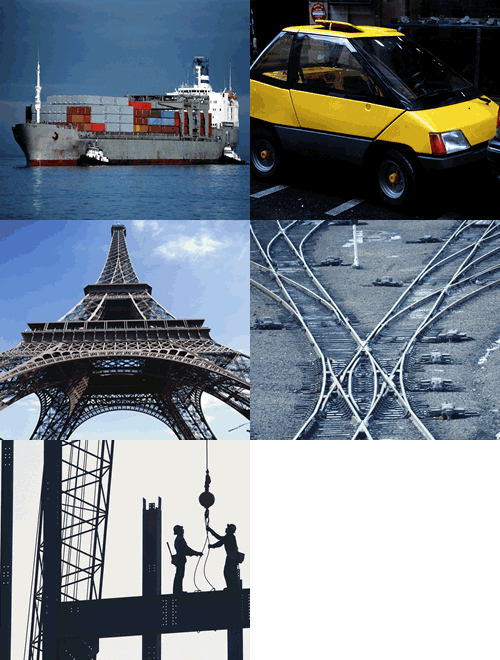 Iron
is cheap and strong and the most used metal in the world. Iron, as produced in
the blast furnace is called pig iron. This is brittle because it contains about
4% carbon and other non-metal impurities. Most of this iron is converted into a
variety of steels by removing nearly all the carbon, and adding small quantities
of different metals. The different steels are alloys which are mixtures of
metals. They have different properties such as toughness, hardness, corrosion
resistance, etc.
Iron
is cheap and strong and the most used metal in the world. Iron, as produced in
the blast furnace is called pig iron. This is brittle because it contains about
4% carbon and other non-metal impurities. Most of this iron is converted into a
variety of steels by removing nearly all the carbon, and adding small quantities
of different metals. The different steels are alloys which are mixtures of
metals. They have different properties such as toughness, hardness, corrosion
resistance, etc.
Some background
The method of using carbon to reduce iron oxide to iron was very probably
discovered accidentally in prehistoric camp fires. Here, charcoal would have
been the source of carbon. The iron was used to make tools and weapons and gave
its name to the Iron Age.
Early in the 18th century, Abraham Darby in Shropshire discovered a method of
converting coal to coke as a source of carbon. This led to the modern blast
furnace.
In the mid 19th century, Henry Bessemer developed a steel-making process that
used oxygen to burn off some of the carbon in cast iron. The Basic Oxygen
Steelmaking process was introduced in the 1950s and now accounts for about
two-thirds of steel production.
Iron and steel: fact file
| World production |
Iron |
560 million tonnes per year |
| Steel |
750 million tonnes per year |
| UK production |
Iron |
13 million tonnes per year |
| Steel |
18 million tonnes per year |
| Manufacture |
|
Blast furnace / Basic Oxygen Steelmaking |
| Raw material |
|
Iron ore, coke and limestone |
| Steel production figures include recycled steel which explains why the
production of steel is greater than that of iron.
Most iron is converted into steel. A little is cast to make components
such as the engine blocks of vehicles.
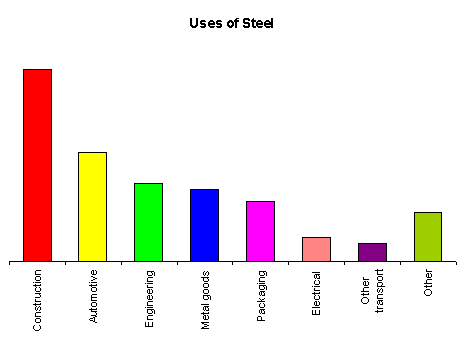
|
 |
Construction |
32% |
 |
Automotive |
18% |
 |
Mechnical engineering |
13% |
 |
Metal goods |
12% |
 |
Packaging |
10% |
 |
Electrical engineering |
4% |
 |
Other transport |
3% |
 |
Other |
8% |
 |
 |
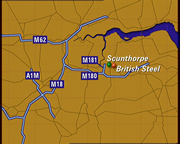
| Map |
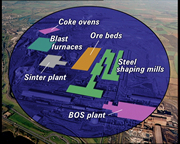
Aerial view of plant |
 |
 |
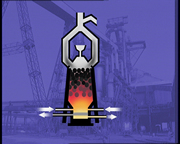
| Unlabelled blast furnace diagram |
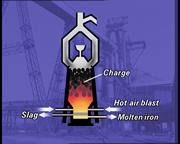
Labelled blast furnace diagram |
 |
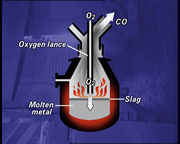 |
| Unlabelled diagram of the BOS process |
Labelled diagram of the BOS process |
Iron and steel: on the web
last update March 2006


