Nylon: introduction
 Nylon
is a synthetic material. There are a number of different types of Nylon. The one
described here is called Nylon 6.6, because it is made from two different
monomers each of which has six carbon atoms. Variants such as Nylon 6.10 are
also made and have slightly different properties. Other Nylons are made from a
single type of monomer and are called Nylon 6, Nylon 11 etc.
Nylon
is a synthetic material. There are a number of different types of Nylon. The one
described here is called Nylon 6.6, because it is made from two different
monomers each of which has six carbon atoms. Variants such as Nylon 6.10 are
also made and have slightly different properties. Other Nylons are made from a
single type of monomer and are called Nylon 6, Nylon 11 etc.
Nylon is seen in fibres, to make tights for example, and also moulded to make
small engineering components such as gear wheels.
Some background
Nylon was first produced in the laboratory by William Carothers, working for
the DuPont company in the United States in 1935. Industrial production began
soon after. Nylon was originally developed as a replacement for silk for
stockings, but during the Second World War, it was used for parachutes, and
Nylon stockings became part of the illegal black market. Carothers suffered from
depression and took his own life in 1937 before Nylon had come onto the market.
Nylon: fact file
| World production |
5.4 million tonnes per year |
| UK production |
300 000 tonnes per year (including 120 000 tonnes which is exported
as Nylon salt) |
| Manufacture |
Condensation polymerisation |
| Raw material |
Cyclohexane and adiponitrile, which are both derived from
crude oil
|
 |
Transportation |
44% |
 |
Electrical/electronic |
21% |
 |
Housewares |
9% |
 |
Industrial equipment |
5% |
 |
Other, including building, sports and medical applications |
21% |
 |
 |
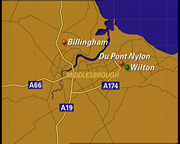
| Map |
Aerial view of plant |
 |
 |
| Process diagram #1 |
Process diagram #2 |
 |
 |
| Polymerisation #1 |
Polymerisation #2 |
 |
 |
| Polymerisation #3 |
Polymerisation #4 |
 |
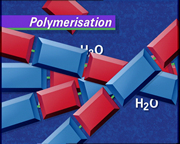 |
| Polymerisation #5 |
Polymerisation #6 |
 |
| Polymerisation #7 |
Nylon: on the web
last update March 2006


