ISSR CLASSES
Checkpoint Science
iGCSE Chemistry
iGCSE Physics
iGCSE Coordinated Science
A-Level Chemistry
PRACTICALS
Practicals Home
Practicals A-Z
Study Plan for Practical Work
In order to work out the hydrogen ion concentration from the pH we need to re-arrange the pH equation (which you should learn!):
|
pH = - log10[H+] |
We first multiply both sides by -1 to get rid of the minus side on the right hand side:
- pH = log10[H+]
|
|
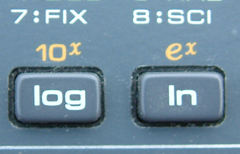
As we want [H+], we also need to get rid of the log10 function on the right hand side. If you check on your calculator you will see that the reverse function to log10 is 10x, so: |
|
[H+] = 10-pH |
Less mathematically inclined students may prefer to express this in the same way as their calculator. So, [H+] = inv log (-pH) or [H+] = shift log (-pH) or [H+] = 2nd function log (-pH).
Get some practice in using your own calculator by working out the hydrogen ion concentration ([H+]) for the following solutions. It is interesting to note that even alkaline solution contain hydrogen ions (though the concentration is small and less than [OH-]).
|
Solution |
[H+] (mol dm-3) |
||
|
0.0500 M HCl (pH 1.30) |
|
||
|
0.0500 M ethanoic acid (pH 3.04) |
|
||
|
Neutral water (pH 7.00) |
|
||
|
0.0500 M NaOH (pH 12.70) |
|