ISSR CLASSES
Checkpoint Science
iGCSE Chemistry
iGCSE Physics
iGCSE Coordinated Science
A-Level Chemistry
PRACTICALS
Practicals Home
Practicals A-Z
Study Plan for Practical Work
We first need to consider why the rate of a reaction increases as the temperature is raised. At higher temperature the reactant molecules will be moving more quickly and will, therefore, collide more frequently. This will result in an increased reaction rate. However, the increase in reaction rate with temperature is much greater than can be explained by this factor alone. There must be another process operating.
|
|
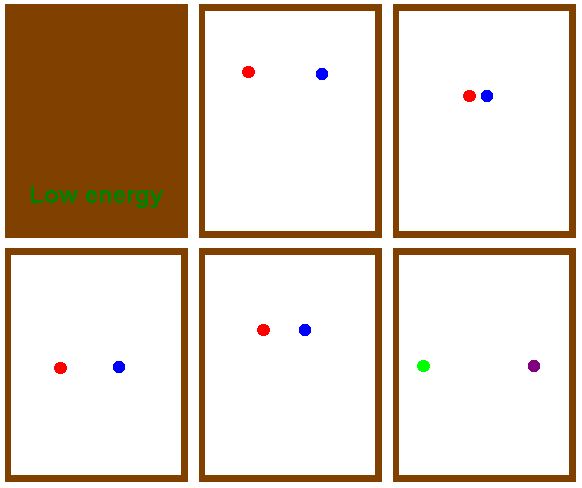
We can, using a little mathematics, calculate how many collisions take place between the reacting molecules each second. If we do this it turns out that, at ordinary temperatures, this collision rate is enormously large. If each collision led to a successful reaction, then all reactions would be completed almost instantaneously at ordinary temperatures. As this does not happen in reality, it must be that not all collisions lead to successful reactions. Indeed, only a very small proportion of collisions will normally produce a reaction. Most colliding molecules simply do not have enough energy to react and merely bounce of each other. Energy is needed for the molecules to break their old bonds before new ones can form. The minimum amount of energy necessary for a reaction to occur is called the activation energy, Ea. |
At higher temperatures a greater proportion of the colliding molecules possess this activation energy, and so produce successful reactions on collision. This is the main reason for the greatly increased reaction rate at higher temperature. It is illustrated graphically in the Maxwell-Boltzmann distribution. This shows how molecules have a range of energies at a given temperature, and how this distribution changes with temperature:

The diagram shows that at the higher temperature, T2, more of the molecules (indicated by the area in blue) possess the necessary activation energy for the reaction.