ISSR CLASSES
Checkpoint Science
iGCSE Chemistry
iGCSE Physics
iGCSE Coordinated Science
A-Level Chemistry
PRACTICALS
Practicals Home
Practicals A-Z
Study Plan for Practical Work
100 cm3 of pH 7.0 buffer needs to be made from some 0.1 mol dm-3 potassium dihydrogenphosphate (KH2PO4) solution and 0.1 M dipotassium hydrogenphosphate (K2HPO4) solution. The following equilibrium is set up:
|
H2PO4-(aq) |
and the Ka has a value of 1.39 × 10⁻⁷ mol dm-3. Calculate the appropriate volumes of the solutions which need to be used.
pKa = - log10Ka = - log10(1.39 × 10⁻⁷) = 6.86
We need to use the following rearranged equation
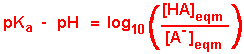
This gives 6.86 - 7.0 = - 0.14 = log10([HA]/[A-]
[HA] = [H2PO4-] and [A-] = [HPO42-]
log10([H2PO4-]/[HPO42-]) = - 0.14
We remove the log with the 10x (inv log) function
So [H2PO4-]/[HPO42-] = 10-0.14 = 0.72
As the two solutions have the same concentration, we could achieve this ratio with 0.72 cm3 of H2PO4- and 1 cm3 of HPO42-. This would only have a total volume of 1.72 cm3 and we are looking for 100 cm3.
We need 100/1.72 = 58.1 lots of 1.72 cm3
So we need 58.1 × 1 = 58.1 cm3 of HPO42-
and 58.1 × 0.72 = 41.9 cm3 of H2PO4-
 HPO42
HPO42