ISSR CLASSES
Checkpoint Science
iGCSE Chemistry
iGCSE Physics
iGCSE Coordinated Science
A-Level Chemistry
PRACTICALS
Practicals Home
Practicals A-Z
Study Plan for Practical Work
Calculation of equilibrium constant
Average titre = 7.3 cm3
Number of moles of potassium thiocyanate = 0.020 ´ 7.3/1000
|
KCNS(aq) + AgNO3(aq) ⇒ AgCNS(s) + KNO3(aq) |
Ag+(aq) º KCNS(aq)
\ number of moles of Ag+(aq) in 10 cm3 = 0.020 ´ 7.3/1000
\ number of moles of Ag+(aq) in 1000 cm3 = 0.020 ´ 7.3/1000 ´ 100 = 0.0146 mol dm-3
[Ag+(aq)]eqm = 0.0146 mol dm-3
As we started with the same concentration of Ag+ ions and Fe2+ ions, and they reacted in a 1:1 ratio, the equilibrium concentrations of these two ions must be the same.
[Fe2+(aq)]eqm = 0.0146 mol dm-3
The Fe2+ ions which have "disappeared" have been converted to Fe3+ ions:
[Fe2+(aq)]initial = 0.05 mol dm-3 (this is half of 0.1 mol dm-3 as it was diluted down by the added silver nitrate solution)
\ [Fe3+(aq)]eqm = [Fe2+(aq)]initial - [Fe2+(aq)]eqm = 0.05 - 0.0146 = 0.0354 mol dm-3
These concentration terms are now put into the Kc expression:
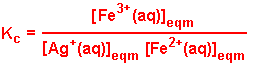
Kc = 0.0354/(0.0146 ´ 0.0146) = 166 mol-1 dm3 at room temperature