ISSR CLASSES
Checkpoint Science
iGCSE Chemistry
iGCSE Physics
iGCSE Coordinated Science
A-Level Chemistry
PRACTICALS
Practicals Home
Practicals A-Z
Study Plan for Practical Work
The simplest method of carrying out this experiment involves just measuring the start temperature and then the highest or lowest temperature reached.
In order to measure how rapidly cooling or warming takes place we need to measure a sequence of temperatures with time. The resulting graph has a characteristic shape. In an exothermic reaction we see a rapid increase in temperature as the reaction takes place, which then slows and is followed by a cooling phase. If we extrapolate (extend) the cooling phase, with a line of best fit, we can estimate what temperature would have been reached without cooling taking place. This gives a better result as is seen in the following graph
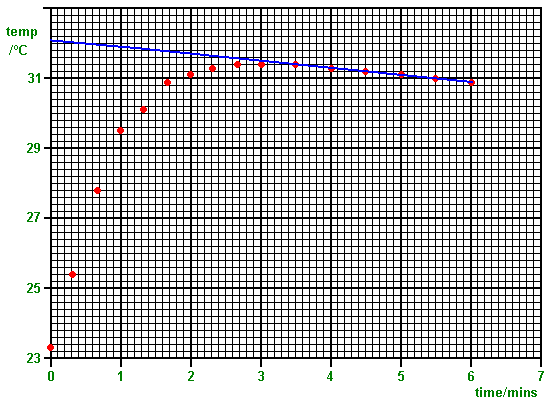
In the above graph, the reaction is largely complete after three minutes and we then see the almost linear cooling phase. The highest temperature reached in this experiment was 31.4 ºC (at around three minutes). However, by allowing for cooling we get a highest temperature (the blue line at time 0) of 32.1 ºC.
The original temperature rise was 8.1 ºC which we are now reading as 8.8 ºC. We have removed an error of 0.7/8.8 × 100 = 8%. There is a slight error in this method which the physicists should spot. This error is ignored, but if you're interested you can find out more here .
We have not eliminated the heat loss error, but it has been reduced. There is still heat lost that we have not accounted for. This is because in our calculation we assume only the water has absorbed the heat, but some will have been absorbed by the plastic cup and the thermometer.
|
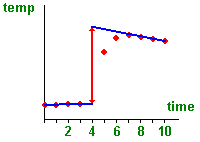
In some specification assessments you are asked to measure the temperature of the starting solution in the plastic cup at regular intervals. For example, every minute for three minutes. On four minutes you add the other reactant but do not measure the temperature. You then measure the temperature regularly for several minutes. By extrapolating the two lines to four minutes you predict the maximum change in temperature. You need to stir throughout. |
|
Ideally you will have allowed all of the chemicals and apparatus to come to room temperature in the lab. This would mean that your first three temperature measurements would be identical. I cannot see any benefit to this method. I would much prefer to allow enough time for the thermometer to take a steady reading of the initial solution. The temperature is taken, and a second later the clock is started and the second reactant added simultaneously. However, you must follow your instructions to gain full credit.