ISSR CLASSES
Checkpoint Science
iGCSE Chemistry
iGCSE Physics
iGCSE Coordinated Science
A-Level Chemistry
PRACTICALS
Practicals Home
Practicals A-Z
Study Plan for Practical Work
|
|
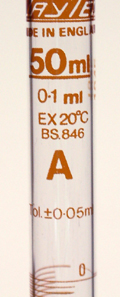
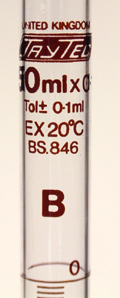
Volumetric glassware (pipettes, burettes, volumetric flasks) come in two levels of accuracy. For school and college work the cheaper class B glassware is generally satisfactory. Class A glassware is calibrated more accurately and often comes with its own certificate of accuracy. The table below shows the tolerances (possible deviation from the true value) of typical class A and class B glassware: |
|
| Volumetric flask | Bulb pipette | Burette | ||||||
| size (cm3) | class A | class B | size (cm3) | class A | class B | size (cm3) | class A | class B |
| 10 | ± 0.02 | ± 0.04 | 1 | ± 0.006 | ± 0.012 | 10 | ± 0.02 | ± 0.04 |
| 25 | ± 0.03 | ± 0.06 | 5 | ± 0.01 | ± 0.02 | 25 | ± 0.03 | ± 0.06 |
| 50 | ± 0.05 | ± 0.10 | 10 | ± 0.02 | ± 0.04 | 50 | ± 0.05 | ± 0.10 |
| 100 | ± 0.08 | ± 0.16 | 25 | ± 0.03 | ± 0.06 | 100 | ± 0.10 | ± 0.20 |
| 250 | ± 0.12 | ± 0.24 | 50 | ± 0.05 | ± 0.10 | |||
| 500 | ± 0.20 | ± 0.40 | 100 | ± 0.08 | ± 0.16 | |||
| 1000 | ± 0.30 | ± 0.60 | ||||||
|
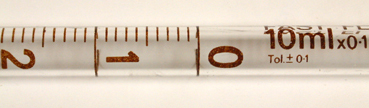
Note that graduated pipettes are less accurate than the corresponding bulb pipette. This can be seen by comparing the tolerance stated on the graduated pipette in the photograph opposite with the value in the table above for bulb pipettes. |
|
|
Measuring cylinders are less accurate pieces of equipment for volume measurement. As a rough guide a measuring cylinder will be accurate to ± half of a marked division. Most 10 cm3 cylinder have 0.2 cm3 divisions, giving a tolerance of ± 0.1 cm3. Always use the smallest measuring cylinder possible, as this gives the smallest percentage error. To confirm this, work out the percentage error in measuring out 10 cm3 of liquid with a 10 cm3 cylinder and then using a 100 cm3 measuring cylinder. Check your answers here . |
Measuring cylinder | |||
| size (cm3) | class A | class B | ||
| 10 | ± 0.08 | ± 0.1 | ||
| 25 | ± 0.14 | ± 0.3 | ||
| 50 | ± 0.20 | ± 0.4 | ||
| 100 | ± 0.35 | ± 0.6 | ||
| 250 | ± 0.65 | ± 1.4 | ||
| 500 | ± 1.10 | ± 2.0 | ||
| 1000 | ± 2.00 | ± 6.0 | ||
We also need to remember that pipettes and burettes are designed to deliver liquids. Volumetric flasks and measuring cylinders are designed to contain liquids. If we transfer liquid from a volumetric flask or measuring cylinder, an additional error occurs as some liquid is left behind.