ISSR CLASSES
Checkpoint Science
iGCSE Chemistry
iGCSE Physics
iGCSE Coordinated Science
A-Level Chemistry
PRACTICALS
Practicals Home
Practicals A-Z
Study Plan for Practical Work
The mass spectrum shows the parent ion at m/e 74. This is the relative molecular mass of compound A. A high resolution mass spectrum would enable us to identify the molecular formula, but we should manage without this.
The ir spectrum shows a very broad absorption centred around 3000 cm-1. This indicates the presence of an OH group. Another strong absorption at just above 1700 cm-1 shows a C=O group. More careful analysis of the OH absorption (by checking the absorption frequency in the data book) shows that it is a carboxylic acid OH (significant absorption below 3000 cm-1).
The nmr spectrum shows that the molecule has six hydrogen atoms in three different environments. The single absorption at around d12 confirms a carboxylic acid. The splitting of the other two absorptions indicates that these hydrogens are on adjacent carbon atoms. The 3H is a triplet (showing two adjacent hydrogens) and the 2H is a quartet (showing three adjacent hydrogens). This suggests an ethyl group. d1.1 for the 3H suggests an alkane-like CH3 group, but d2.4 for the 2H indicates a methylene group attached to a positive carbon atom.
|
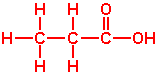
We don't need all this analysis to come up with the answer. It's fairly clear from the ir and the nmr that this is a carboxylic acid. We know that it has a molar mass of 74, so there is only one possibility - the molecule is propanoic acid. |
|
We now check that all the facts fit. We might look for some fragments on the mass spectrum. The loss of the acid H would give a mass of 73, loss of the OH gives a fragment of mass 57, a split to the left of the acid group would give C2H5 = 29 and COOH = 45. All these fragments are present.
A confirmatory chemical test would be effervescence with sodium carbonate solution.