ISSR CLASSES
Checkpoint Science
iGCSE Chemistry
iGCSE Physics
iGCSE Coordinated Science
A-Level Chemistry
PRACTICALS
Practicals Home
Practicals A-Z
Study Plan for Practical Work
The mass spectrum shows the parent ion at m/e 136. This is the relative molecular mass of compound F.
The ir spectrum shows a number of small C-H peaks around 3000 cm-1. There is a clear C=O peak at 1720 cm-1. With such a large mass it is worth a check for an arene. There are absorptions at 1450, 1490, 1580 and 1600 cm-1, although some of them are weak. This indicates that a benzene ring is present.
The nmr spectrum shows 5H between d7.4 and d8.1. This confirms an arene. The 3H singlet at d3.9 could be a methyl group attached to an oxygen atom.
|
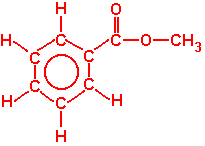
We know that we have a C6H5 ring, a carbonyl group and a methyl group. This has a combined mass of 120, so there must also be an oxygen atom (to give rmm of 136). This fits in with the nmr conclusion that the methyl group was attached directly to an oxygen atom. Putting all this together we conclude that the molecule is methyl benzoate. |
|
We now check that all the facts fit. We might look for some fragments on the mass spectrum. The arene should give prominent fragments at m/e 77 (C6H5) and m/e 105 (C6H5CO). The loss of the methyl (m/e 15) would give a fragment at m/e 121. You might be worried that no fragment is visible at 121. This is not uncommon. Just because it's possible to break a bond does not mean that the fragment will be detected. Little fragmentation may occur if there is an easier bond to break. Even if fragmentation occurs there may be further fragmentation or rearrangement before detection. The very clear peaks at 77 and 105 make us sure that we have the C6H5CO group. With only an O and CH3 to place, our predicted molecule is the only possibility.