ISSR CLASSES
Checkpoint Science
iGCSE Chemistry
iGCSE Physics
iGCSE Coordinated Science
A-Level Chemistry
PRACTICALS
Practicals Home
Practicals A-Z
Study Plan for Practical Work
The mass spectrum shows the parent ion at m/e 72. This is the relative molecular mass of compound G.
The ir spectrum shows a very broad absorption centred around 3000 cm-1. There is a clear C=O peak at 1720 cm-1. These two absorptions indicate a carboxylic acid. There are a couple of peaks at 1420 and 1440 cm-1. This is in the right area for an alkene.
The nmr spectrum clearly confirms the carboxylic acid with a singlet at d12.0. There is a complex set of absorptions at around d6 - 7. This is in the right region for an alkene.
|
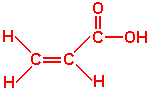
We know that we have a carboxylic acid and an alkene. With a relatively small rmm of 72 there is only one way of putting these clues together. The molecule is propenoic acid (old name acrylic acid). |
|
We now check that all the facts fit. We might look for some fragments on the mass spectrum. The loss of the acid H should give a peak at 71 and loss of the OH a peak at m/e 55. Splitting off the carboxylic acid group gives peaks at m/e 27 and 45. All these fragments are present.
The complex nmr absorptions for the alkene protons show that there is still a lot to learn about nmr spectroscopy (but we'll leave that to university!). You might have expected a doublet for the CH2 protons and a triplet for the CH proton. If you want a challenge think about why this is not the case and check your answer here . Bear in mind that we only needed a simple analysis (that is, the three protons were probably alkene protons) in order to work out the final structure.
This compound will effervesce with sodium carbonate solution and decolourise bromine water.