ISSR CLASSES
Checkpoint Science
iGCSE Chemistry
iGCSE Physics
iGCSE Coordinated Science
A-Level Chemistry
PRACTICALS
Practicals Home
Practicals A-Z
Study Plan for Practical Work
|
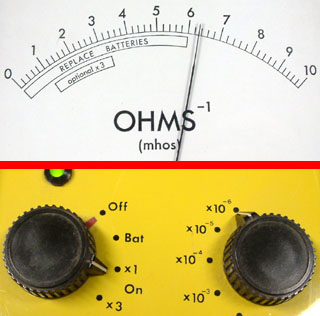
A device which measures the electrical conductivity of a solution. |
|
The electrical conductivity of a solution depends on the number of free moving ions which it contains. Hydrogen ions and hydroxide ions have a particularly high conductivity in aqueous solution. The following table shows a number of ion conductivities:
|
Aqueous cation |
Conductivity/S cm2 mol-1 |
Aqueous anion |
Conductivity/S cm2 mol-1 |
|
Li+ |
39 |
F - |
55 |
|
Na+ |
50 |
NO3- |
71 |
|
K+ |
74 |
Cl - |
76 |
|
Mg2+ |
106 |
I - |
77 |
|
Fe2+ |
108 |
Br - |
78 |
|
Ca2+ |
119 |
SO42- |
160 |
|
Al3+ |
189 |
OH - |
199 |
|
H+ |
350 |
PO43- |
240 |
Conductivity measurements can be used to investigate the degree of ionization in an acid. For example we would expect the conductivity of 0.1 M ethanoic acid to be considerably lower than the conductivity of 0.1 M hydrochloric acid. This provides evidence for the virtually complete ionization of the strong acid (hydrochloric) and the partial ionization of the weak acid (ethanoic).
We can also use conductivity measurements to follow the rate of a reaction, perhaps using a data logger. To do this there must be a significant difference in the conductivities of the reactants and products. For example:
|
C2H5Br + H2O ⇒ C2H5OH + HBr |
in the above reaction the reactants are covalent and of very low conductivity (the water is very slightly ionized). The product, HBr, will be ionized in aqueous solution and of high conductivity. The conductivity of this reaction mixture will rise as the reaction proceeds.
Take a look at the following reaction which takes place in aqueous conditions. What, if any, change will occur as this reaction proceeds?
|
C3H7Cl + NaOH ⇒ C3H7OH + NaCl |