ISSR CLASSES
Checkpoint Science
iGCSE Chemistry
iGCSE Physics
iGCSE Coordinated Science
A-Level Chemistry
PRACTICALS
Practicals Home
Practicals A-Z
Study Plan for Practical Work
The first thing to be absolutely clear about is the difference between a halogen and a halide ion. The halogens are the elements themselves and we have already seen pictures of them. The elements always go around in pairs, giving the formulae F2, Cl2, Br2 and I2. The halides are the negative ions, F-, Cl-, Br- and I-. These cannot be found on their own, but are always paired up with a positive ion in compounds like sodium chloride or potassium iodide. Most of these halide compounds are soluble. The solutions are colourless.
|
It's worth remembering that there is a very big difference between chlorine (a poisonous green gas) and chloride (a relatively harmless ion found in common salt). Students often make the mistake of assuming that a compound will have the same reactivity as the element. For example, an exam question asks why is sodium dichromate used in preference to potassium dichromate in the oxidation of an alcohol. The common wrong answer is that potassium is too reactive. Potassium metal is very reactive (it catches fire in contact with water), but there is no potassium metal in potassium dichromate. It contains potassium ions, which are not very reactive at all. Just for information, the correct answer is that sodium dichromate is more soluble than potassium dichromate so it is easier to dissolve. Don't make the same mistake with the halogens and the halides - they are different things! |
|
You have probably looked at the reactivity series of metals in your GCSE course. The same sort of displacement reactions take place with the halogens. This is illustrated in the following experiment where the more reactive halogen displaces the less reactive halogen from a solution of its halide. Watch the video and try to place the halogens bromine, chlorine and iodine in order of reactivity. Write down balanced equations for any of the reactions that you see. The change in size down the group explains the trend in reactivity:
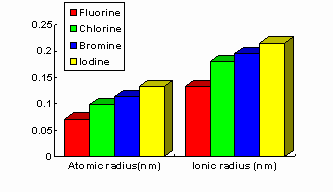
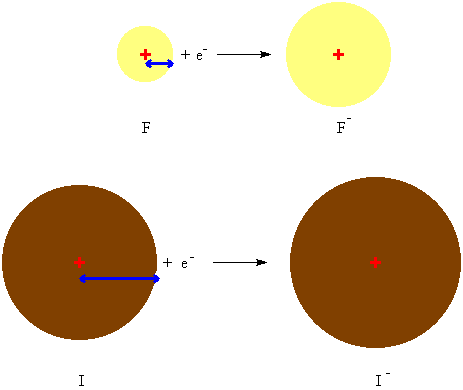
You should have found from the video that the reactivity decreases in the order chlorine, bromine, iodine. Fluorine is the most reactive of the elements in this group and this is because of its small size. The elemental halogens react by attracting electrons and turning into negative ions. As fluorine is the smallest of the halogens this attracted electron can get very close to the nucleus of the fluorine and so is strongly attracted. Iodine, which is much larger than fluorine, has less attraction for the additional electron and is hence less reactive:
The equations for the three reactions are:
|
Cl2(aq) + 2KI(aq) ⇒ I2(aq) + 2KCl(aq) |
|
Cl2(aq) + 2KBr(aq) ⇒ Br2(aq) + 2KCl(aq) |
|
Br2(aq) + 2KI(aq) ⇒ I2(aq) + 2KBr(aq) |
but where the more reactive halogen is already in the compound no reaction occurs:
|
I2(aq) + 2KCl(aq) ⇒ no reaction |
Where a reaction occurs it is often better to write an ionic equation which leaves out any spectator ions. A spectator ion is an ion which appears unchanged in aqueous solution on both sides of the equation. In other words, it has not done anything. As it has not chemically changed it is better to leave it out. In the above three equations split any ionic compound which appears in solution into its constituent ions, then cancel out any which appear on both sides of the equation. You can check your answers here.