ISSR CLASSES
Checkpoint Science
iGCSE Chemistry
iGCSE Physics
iGCSE Coordinated Science
A-Level Chemistry
PRACTICALS
Practicals Home
Practicals A-Z
Study Plan for Practical Work
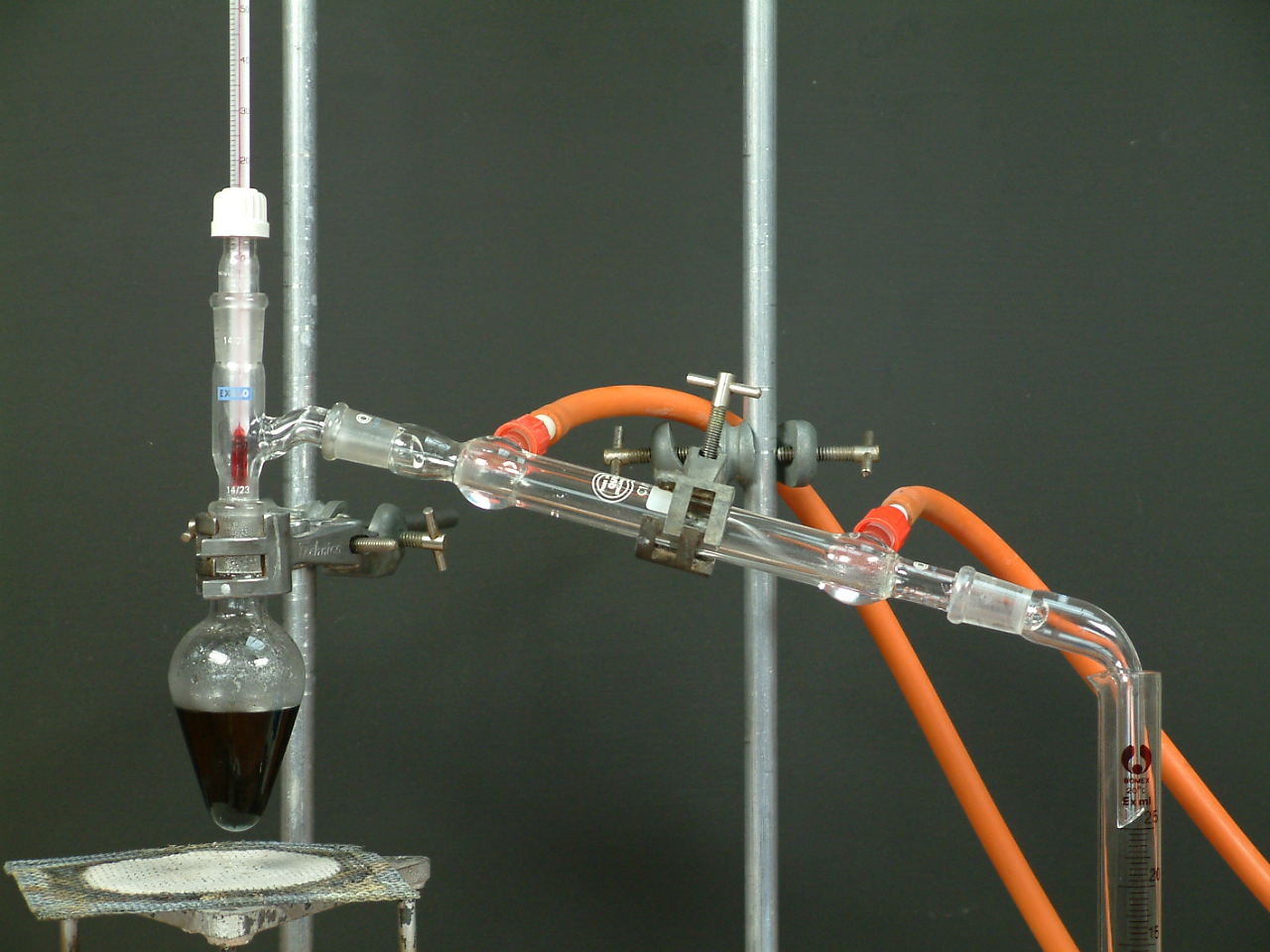
This is the process of boiling a liquid and condensing the resulting vapour. The condensation can be done using the cold water jacket of a Liebig condenser or simply using a glass bend cooled in the air (this is much less efficient).
|
|
Distillation is used in the separation of mixtures of liquids or the separation of a liquid from an involatile material. It is always the last purification stage in the preparation of an organic liquid. Distillation relies on the different boiling points of the liquids concerned. Simple distillation works well if there is a reasonable difference in the boiling points. If the boiling points are close the process of fractional distillation is used. |
|
You should be able to draw out a diagram of a distillation apparatus. The principle of distillation is to collect the liquid which boils at, and just around, the boiling point of the liquid wanted. If you would like to find out more detail about an actual distillation process you might like to look at the distillation case study and video. |
|
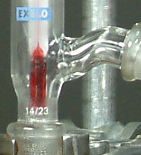
Water entering the condenser at the wrong end. It should enter at the bottom. If it enters at the top there are likely to be air pockets which result in poor condensation. See video.
|
|
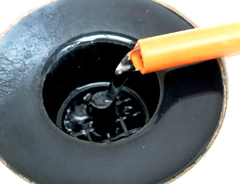
Too fast a flow of water. This may result in flooding. See video |
No flow of water or Liebig condenser attached to the hot tap. Poor condensation.
|
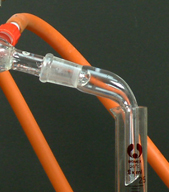
Loose or inadequate clamping possibly leading to later glassware breakage. This is usually the glass bend. The photograph shows that the glass bend in the apparatus is held on simply by the grease. As the apparatus heats up the grease often softens, and the bend drops off. The one in the photograph is acceptable. It is a small bend and has very little distance to fall (the top of the measuring cylinder is high and close to the bend). It would probably survive if it drops off. A better solution is to use a Quickfit clip or another clamp. Your bend may have a small hook on it, enabling it to be attached to the Liebig condenser with an elastic band. |
|
Clamping too tight. The very expensive glassware breaks - you will not be popular!
|
|
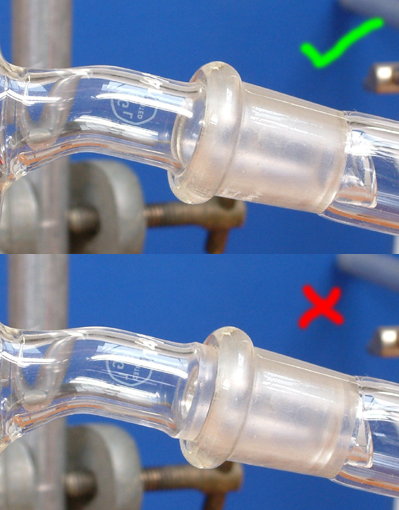
Quickfit not sealing. Always check just prior to heating. The tightening of the clamps often leads to a Quickfit joint coming apart. Vapour will escape from your apparatus and yield will be reduced. There is a safety hazard from organic vapour escaping into the lab. The vapour may also catch fire resulting in another hazard. |
Failure to lightly grease the Quickfit joints leading to apparatus being difficult to pull apart after use.
Excessive heating or flask too full. This may cause the mixture to froth over. It does not distil, and high boiling point components get pushed into the Liebig condenser. This means we shall fail to separate the mixture as intended. Remember that the Bunsen burner can be turned down at the gas tap.
Heating with yellow flame. Messy.
|
Thermometer bulb not in correct place. It should be where the vapour exits in order to measure the boiling temperature of the distillate collected. It may be placed in the liquid in order to measure the liquid boiling point. |
|
No tripod and gauze. The flask can be directly heated if the Bunsen is held and played across the flask so as not to overheat it. However, if the Bunsen is static the flask will overheat leading to bumping and failure of the distillation. The gauze spreads the heat and reduces the probability of overheating. A few anti-bumping granules also encourage smooth boiling.
|
|
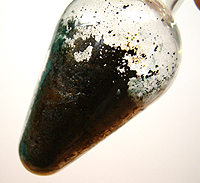
Heating too long. Stop heating before the last bit of liquid is distilled from the flask. If the distillation mixture contains high boiling point inorganic salts they will become hardened on the surface of the flask making it very difficult to clean. Even when all the distillate boils away quite easily, the glass becomes quickly very hot when no more liquid remains. If some drops of distillate drip back down from the stillhead they are likely to char on the very hot glass surface. |