ISSR CLASSES
Checkpoint Science
iGCSE Chemistry
iGCSE Physics
iGCSE Coordinated Science
A-Level Chemistry
PRACTICALS
Practicals Home
Practicals A-Z
Study Plan for Practical Work
Distilled water
|
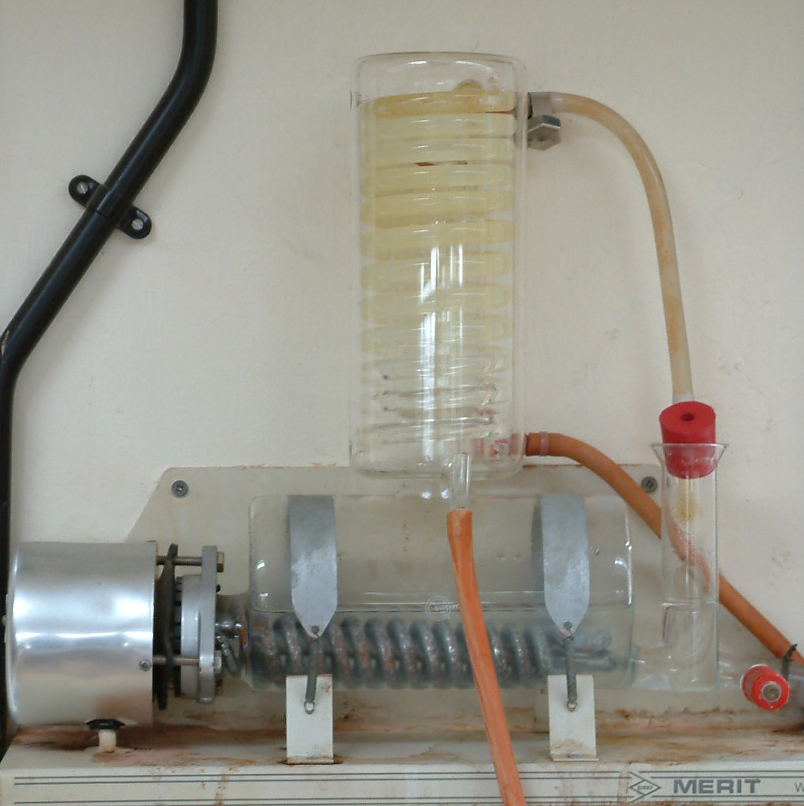
Tap water contains dissolved minerals and is not pure. Generally it should not be used in chemical experiments. We usually use distilled water in the laboratory. This has been boiled and condensed which leaves behind the high boiling point minerals. The photograph shows a typical laboratory still which is used to produce distilled water. |
|
The water is still not entirely pure. It will contain any low boiling point organic chemicals which may have been present in the water before distillation. Even if these were not present it will quickly pick up dissolved carbon dioxide gas from the air. However, for most laboratory experiments its purity is satisfactory. Distilled water is generally dispensed from wash bottles. Remember that the laboratory is a dangerous place - wash bottles are not for playing with.
Another process commonly used in school and college laboratories for water purification is de-ionization. De-ionized water is passed through two ion exchange resins. The first is a cationic exchange resin which replaces any cations (positive ions) with hydrogen ions. Then it is passed through an anionic exchange resin which replaces the negative ions with hydroxide ions. The overall process is to replace all the positive and negative ions with hydrogen and hydroxide ions. The hydrogen and hydroxide ions react with each other to make water! The purity is again limited for the same reasons as with the distilled water.