ISSR CLASSES
Checkpoint Science
iGCSE Chemistry
iGCSE Physics
iGCSE Coordinated Science
A-Level Chemistry
PRACTICALS
Practicals Home
Practicals A-Z
Study Plan for Practical Work
The process in which a compound breaks down when an electric current is passed through it. Electrolysis is important for the manufacture of metals which are high in the reactivity series. Aluminium is a good example of this. The process is also important in electroplating, where a thin layer of metal is deposited on another metal.
|
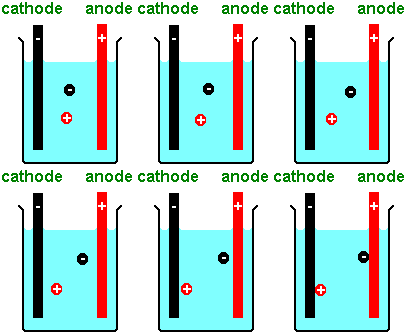
The conductor in electrolysis is known as the electrolyte. As opposites attract, we find the positive ions (cations) move towards the negative cathode, and the negative ions (anions) move towards the positive anode. This movement can be seen in this video. At the electrodes the ions are discharged (lose their charge) by the loss or gain of electrons. |
|
Important electrolysis reactions are the electrolysis of molten sodium chloride, aqueous sodium chloride and aqueous copper(II) sulfate.
Molten sodium chloride
Sodium chloride melts just over 800 ºC. The liquid contains only sodium ions (Na+) and chloride ions (Cl-). The sodium ions will move towards the negative cathode where they gain electrons to form sodium metal:
|
Na+ + e- ⇒ Na |
The chloride ions move towards the positive anode where they lose electrons to form chlorine gas:
|
Cl- - e- ⇒ ½Cl2 |
Aqueous sodium chloride solution
This is complicated by the presence of the water as this provides both hydrogen (H+) and hydroxide ions (OH-). At the cathode (-) there is a choice of hydrogen ions or sodium ions to discharge. The hydrogen ions discharge preferentially to produce hydrogen gas:
|
H+ + e- ⇒ ½H2 |
At the anode (+) there is a choice between hydroxide ions and chloride ions. The chloride ions discharge preferentially to produce chorine gas again:
|
Cl- - e- ⇒ ½Cl2 |
Having discharged the hydrogen and chloride ions, the sodium and hydroxide ions are left behind in the solution. The electrolysis of brine (salt water) is very important as it produces three very useful materials - hydrogen gas, chlorine gas and sodium hydroxide solution.
Aqueous copper(II) sulfate solution
The presence of water gives us a choice of ions to discharge again. At the cathode (-) either copper(II) or hydrogen ions are available. It is the copper(II) ions which discharge to produce copper metal. Consequently, a metal object placed at the cathode becomes copper plated:
|
Cu2+ + 2e- ⇒ Cu |
At the anode (+) we have a choice of hydroxide and sulfate ions. The hydroxide ions discharge, producing oxygen gas:
|
2OH- - 2e- ⇒ H2O + ½O2 |
You should be able to work out what happens to the pH of the solution as the electrolysis proceeds. Check your answer here .