ISSR CLASSES
Checkpoint Science
iGCSE Chemistry
iGCSE Physics
iGCSE Coordinated Science
A-Level Chemistry
PRACTICALS
Practicals Home
Practicals A-Z
Study Plan for Practical Work
Enthalpy change of solution
This is the enthalpy change when one mole of a substance dissolves in a solvent to form an infinitely dilute solution. For a substance, AB(s), dissolving in water, it would be represented by the following equation:
|
AB(s) + aq ⇒ A+(aq) + B-(aq) |
|
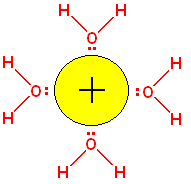
When an ionic compound dissolves we must separate the ions. They attract each other strongly, and the energy required to separate them is the reverse of the lattice energy. However, once separated, the highly charged ions attract the solvent molecules. The positive ions attract the negative ends of the solvent molecules, and the negative ions attract the positive ends of the solvent molecules. This process is called solvation, and the ions are said to be solvated. The most usual solvent for ionic compounds is water. The process is then called hydration and the ions are said to be hydrated: |
|
This hydration process releases a large amount of energy, and this has to be balanced against the minus lattice energy required to separate the ions in the first place. When these two enthalpy values are added together we get the enthalpy of solution, which may be exothermic or endothermic depending on which of the two figures is biggest:
|
- lattice energy + enthalpy of hydration = enthalpy of solution |
Remember, minus lattice energy is the enthalpy change for the following process:
|
A+B-(s) ⇒ A+(g) + B-(g) |
Enthalpy of hydration (or hydration energy) is represented by the following change:
|
A+(g) + B-(g) + aq ⇒ A+(aq) + B-(aq) |
and the overall process, enthalpy of solution is:
|
A+B-(s) + aq ⇒ A+(aq) + B-(aq) |
We can work out the enthalpy change for this last process using the following equation:
|
DH = SDHf(products) - SDHf (reactants) |
Enthalpies of formation for aqueous ions and lattice energies can be found in a data book. Some examples:
Example 1: What is the enthalpy of solution of sodium chloride?
This is the process Na+Cl-(s) + aq ⇒ Na+(aq) + Cl-(aq)
DHf(Na+(aq)) = - 240.1 kJ mol-1
DHf(Cl-(aq)) = - 167.2 kJ mol-1
DHf(Na+Cl-(s)) = - 411.2 kJ mol-1
DHsolution = - 240.1 + - 167.2 - - 411.2 = + 3.9 kJ mol-1
Example 2: What is the enthalpy of solution of ammonium sulfate?
This is the process (NH4+)2SO42- (s) + aq ® 2NH4+ (aq) + SO42- (aq)
DHf(NH4+ (aq)) = - 132.5 kJ mol-1
DHf(SO42- (aq)) = - 909.3 kJ mol-1
DHf((NH4+)2SO42- (s)) = - 1180.9 kJ mol-1
DHsolution = 2 × - 132.5 + - 909.3 - - 1180.9 = + 6.6 kJ mol-1