ISSR CLASSES
Checkpoint Science
iGCSE Chemistry
iGCSE Physics
iGCSE Coordinated Science
A-Level Chemistry
PRACTICALS
Practicals Home
Practicals A-Z
Study Plan for Practical Work
The equilibrium law
This is a mathematical expression which links together the various concentration terms of a reversible reaction when it is in equilibrium. It is important to realize that it only applies to a system in equilibrium, and that some reactions take some time to reach equilibrium.
The equilibrium law expression multiplies all the product concentrations, raised to their appropriate stoichiometric powers, and divides them by all the reactant concentrations, raised to their appropriate stoichiometric powers. Students often remember this as "products over reactants". Stoichiometric simply means the number of molecules in the equation! It is much easier than it sounds - a few examples should make it clear. For the general reaction:
|
aA(g) + bB(g) |
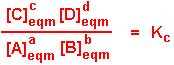
Kc is a constant at a given temperature, and is called the equilibrium constant. Only gases and substances in solution can have variable concentrations, and so these are the only things which are included in the equilibrium law expression. In other words, leave out any solids or pure liquids.
The units of Kc depend on the actual reaction involved. Remember, each concentration term has the units mol dm-3. You will have to count the total number of concentration terms on the top and bottom of the expression, and cancel them appropriately. Again, a few examples should make this clear:
Example 1:
|
H2(g) + I2(g) |
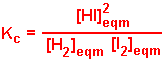
There are two concentration terms on the top of this expression and two on the bottom. As these will cancel out this Kc has no units (sometimes called dimensionless).
Example 2:
|
CaCO3(s) |
Kc = [CO2]eqm
Remember solids do not appear in the equilibrium law expression. As this has only one concentration term on the top of the expression the units of this Kc are mol dm-3.
Example 3:
|
N2(g) + 3H2(g) |
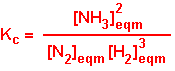
There are four concentration terms on the bottom of the expression and two on the top. We can cancel two of these leaving two terms on the bottom. That is, the units of Kc are 1/(mol dm-3) ´ (mol dm-3). When powers are multiplied together, we add the powers - this can be seen with some simple maths:
A2 = A ´ A and A3 = A ´ A ´ A
|
This means A2 ´ A3 = A ´ A ´ A ´ A ´ A = A5 |
[NB it is NOT A6] |
Multiplying out the powers above, we get the units of Kc to be 1/(mol2 dm-6). To move units to the top of an expression you need to change the sign of the index. Changing the signs we get the units mol-2 dm6.
Example 4:
|
C(s) + H2O(g) |
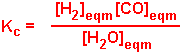
Don't forget to leave out the solid. There are two concentration terms on the top of the expression and one on the bottom. We can cancel one of these leaving one on the top. So the units are mol dm-3.
If Kc is large, there is a much higher concentration of products than reactants. Similarly, if Kc is small, the reactants predominate, and there is little product. If Kc is about 1, then there are roughly equal quantities of products and reactants.
Experiment - measuring an equilibrium constant
 cC(g) + dD(g)