ISSR CLASSES
Checkpoint Science
iGCSE Chemistry
iGCSE Physics
iGCSE Coordinated Science
A-Level Chemistry
PRACTICALS
Practicals Home
Practicals A-Z
Study Plan for Practical Work
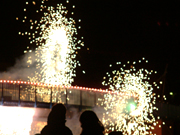 |
When a metal compound is placed in a blue Bunsen flame it often gives a colour to the flame. This effect is used to give the colour to fireworks, and can be used to identify the metal ions present in an unknown sample. Identification of an unknown is done by a process known as atomic absorption spectrophotometry. |
|
The analysis of the spectrum of these flame colours leads to important conclusions about the structure of the atom. You are often asked in exams about the origins of these line emission spectra. |
|
The practical is quite straightforward, and is also a source of frequent examination questions.
|
|
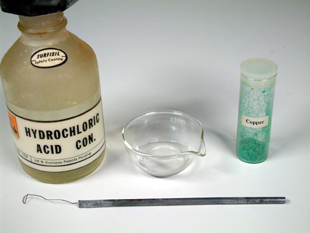
A nichrome or platinum wire is used as this is inert and gives no colour to the flame. It must be thoroughly cleaned using concentrated hydrochloric acid. When it is placed in the flame and gives no colour then it is clean. If not it must be cleaned again in the acid. A small amount of the metal compound is then picked up on the wire and placed in the flame so that the colour can be observed. |
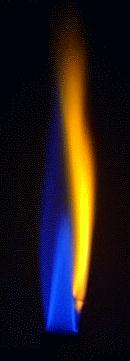
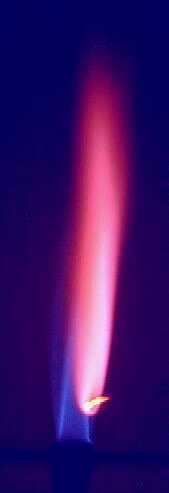
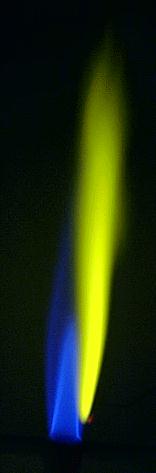
We tend to use metal chlorides for the samples as these have low boiling points and so volatilize easily. This gives a good colour to the Bunsen flame. It is best to view the flames in a darkened room. A direct vision spectrometer produces a spectrum from the emitted light and the individual lines of colour can be seen. Click on the pictures below for a larger image:
|
|
|
|
|
|
|
|
Li |
Na |
K |
Ca |
Sr |
Ba |
|
|
From the transition metals, copper gives an interesting flame colour. It is usually green, but at the right flame temperature it gives a blue colour. It is very useful in firework manufacture for the production of a blue flame. |