ISSR CLASSES
Checkpoint Science
iGCSE Chemistry
iGCSE Physics
iGCSE Coordinated Science
A-Level Chemistry
PRACTICALS
Practicals Home
Practicals A-Z
Study Plan for Practical Work
The process in which one substance crystallizes preferentially from a solution containing two or more salts.
This is best illustrated with an example:
In the experiment to prepare potassium iodate(V) we use the following reaction:
|
6KOH(aq) + 3I2(aq) ⇒ 5KI(aq) + KIO3 (aq) + 3H2O(aq) |
The equation shows that the solution produced by this reaction contains both potassium iodide and potassium iodate(V) in a 5:1 ratio.
|
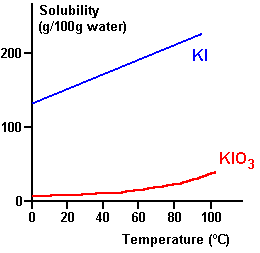
The reaction is carried out in a boiling water bath at which temperature both products remain dissolved. However, as the solution cools the solubility of both salts decreases. We need to look at the solubility graph in order to see what will happen. Whilst there are more moles of potassium iodide, it is much more soluble than the potassium iodate(V) throughout the temperature range. This means, on cooling, the potassium iodide should remain in solution with a small amount of potassium iodate(V). The solid product which forms should largely be potassium iodate(V) as its solubility drops significantly on cooling. |
|
Assuming 100 grams of solution is saturated with potassium iodate(V) at 100 ºC, this would contain around 30 grams of KIO3 (see graph). According to the equation, if we have made 30 grams of potassium iodate(V), we shall also have 116 grams of potassium iodide. On cooling to 20 ºC the solubility of the potassium iodate(V) drops to about 8 grams. So 22 grams (around three quarters) should precipitate. However, the solubility of the potassium iodide at 20 ºC is still about 140 grams, so this should remain in solution.
We use suction filtration to remove the solid product from the solution. A little cold water is used to wash any remaining solution from the crystals - if too much water is used the crystals will dissolve leaving very little (or no!) product. The crystals are dried with clean, dry filter paper and then placed in a desiccator.