ISSR CLASSES
Checkpoint Science
iGCSE Chemistry
iGCSE Physics
iGCSE Coordinated Science
A-Level Chemistry
PRACTICALS
Practicals Home
Practicals A-Z
Study Plan for Practical Work
|
|
It is often helpful to know whether a gas is more or less dense than air. This is quite easy to work out as equal volumes of gases contain the same number of particles (provided that the temperature and pressure are the same). This means that the heavier the particles of gas are, the more dense it will be. Air is a mixture of around 79% nitrogen and 21% oxygen. N2 = 28 and O2 = 32. A weighted average calculation gives the average mass of the particles in air as 28.8. If the particles of a gas have a mass greater than this then the gas will be more dense than air. Similarly, if the particles of a gas have a mass less than 28.8 then the gas will be less dense than air. |
Examples
Hydrogen = H2 = 2. This is less than 28.8, so hydrogen is (a lot) less dense than air. This explains why it used to be used in balloons like the Hindenberg. However, the extreme flammability of this gas means that it has now been replaced by the more expensive, but much safer, helium. He = 4, also less dense than air.
|
Carbon dioxide = CO2 = 44. This is greater than 28.8, so carbon dioxide is more dense than air. This is one of the reasons that it is used in fire extinguishers. It sinks and forms a blanket over the fire so preventing oxygen getting to it. |
|
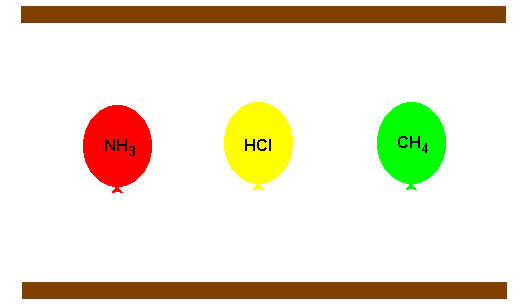
Use the above theory to decide if the gases in the following picture are more or less dense than air. Click on the image to check your answer.