ISSR CLASSES
Checkpoint Science
iGCSE Chemistry
iGCSE Physics
iGCSE Coordinated Science
A-Level Chemistry
PRACTICALS
Practicals Home
Practicals A-Z
Study Plan for Practical Work
An anhydrous metal carbonate is known to be one of the following: Na2CO3, K2CO3, Rb2CO3, MgCO3 or CaCO3. Carbonates react with acid to produce carbon dioxide gas:
|
CO32-(s) + 2H+(aq) ⇒ H2O(l) + CO2(g) |
Plan an experiment to measure the volume of carbon dioxide gas produced and hence determine the correct formula of the carbonate.
The first exercise is to calculate a suitable mass of the carbonate to use. This is complicated by the fact that we do not know which carbonate is involved:
Na2CO3 = 106, K2CO3 = 138, Rb2CO3 = 231, MgCO3 = 84, CaCO3 = 100
We don't want to have more than 90 cm3 of gas or we shall risk going off the scale.
90 cm3 of gas = 90/24000 = 0.00375 mol at RTP
For MgCO3, mass = 0.00375 × 84 = 0.32 g
If we use more than 0.32 g and it turns out to be MgCO3 we may go off the scale or even see the plunger drop out. If it turns out to be one of the other carbonates, 0.32 g will contain less moles, so a smaller volume of gas will be formed.
For Rb2CO3, volume of gas = 0.32/231 × 24000 = 33 cm3
If we obtain such a low volume in our first (trial) experiment we could repeat using a larger mass of the carbonate.
Now we need to decide on a suitable volume of hydrochloric acid to give an excess. From the equation:
2H+ º CO32-
So for 0.00375 moles of gas we need 0.00375 × 2 = 0.0075 moles of HCl
Dilute 1.0 M acid is the most readily available

Volume of 1.0 M acid = 0.0075/1.0 = 0.0075 dm3 = 7.5 cm3
\ we shall use 10 cm3 of 1.0 M HCl as an excess
Method
We shall use the side-arm test tube and gas syringe apparatus. Weigh by difference accurately no more than 0.32 grams of solid carbonate into the clean, dry side arm test tube. Add 10 cm3 of 1.0M hydrochloric acid, stopper quickly and measure the final volume of carbon dioxide gas collected.
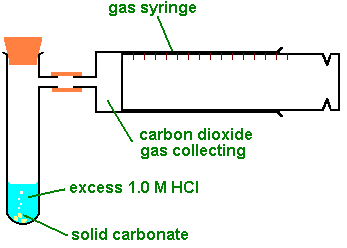
Results
With 0.319 grams of the carbonate 34.5 cm3 of carbon dioxide gas was collected. However, the reaction is very rapid as soon as the acid is added. It was noticed that a large amount of the gas escaped before it was possible to insert the bung. Consequently, the measured volume of gas is significantly less than the actual amount. This error is too large to produce meaningful results.
Rethink the design of the apparatus to prevent this early loss of gas.