ISSR CLASSES
Checkpoint Science
iGCSE Chemistry
iGCSE Physics
iGCSE Coordinated Science
A-Level Chemistry
PRACTICALS
Practicals Home
Practicals A-Z
Study Plan for Practical Work
The halogenoalkanes are alkanes in which one or more of the hydrogen atoms have been replaced by halogen atoms. At "A" level we usually only meet chlorine, bromine and iodine as the halogen atom.
|
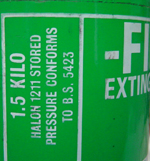
There are few naturally occurring halogenoalkanes. Thyroxin, a hormone produced in the body by the thyroid gland, is a natural iodine-containing compound. Man-made halogenoalkanes are used for a variety of purposes, including synthesis (making other compounds), anaesthetics and fire extinguishers. |
|
Halogenoalkanes are classified as primary, secondary and tertiary in the same way as the alcohols.
Halogenoalkanes are named using the prefixes chloro-, bromo- and iodo-, giving names of the type haloalkane. An identifying number must be used if there is a possibility of isomerism. With more than one halogen, they are placed in alphabetical order (ignoring any di, tri etc).
Examples
|
|
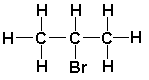
The structural formula is CH3CHBrCH3 This is 2-bromopropane. A number is needed as 1-bromopropane is a possible isomer. |
|
|
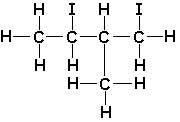
The structural formula is CH3CHICH(CH3)CHI There are four carbon atoms in the longest chain and one methyl side chain. We number the chain in order to give the smallest numbers. This molecule is called 1,3-di-iodo-2-methylbutane. |
|
|
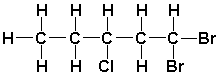
The structural formula is CH3CH2CHClCH2CHBr2 With the bromo and chloro in alphabetical order and using the smallest numbers we get 1,1-dibromo-3-chloropentane. |
|
|
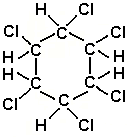
This is a six-membered ring with six chlorine atoms. It is called 1,2,3,4,5,6-hexachlorocyclohexane. It is an insecticide. |
Halogenoalkanes are immiscible with water. They generally react by nucleophilic substitution.
Work through each section below and make appropriate observations. Check your answers in the results link at the bottom of the page.
1 Reaction with aqueous alkali
It is important to ensure that the reaction mixture is fully neutralized with dilute nitric acid before testing with silver nitrate solution. If this is done, a white precipitate of silver chloride is formed. What type of organic reaction has occurred here? Try to write an equation for the reaction.
Video - the reaction of 2-chloro-2-methylpropane with aqueous alkali
2 A comparison of halogenoalkanes
This experiment compares the rate of hydrolysis of a halogenoalkane with silver nitrate solution, using a range of halogenoalkanes. In the video we have added the hot silver nitrate solution to the three samples simultaneously, and checked for the order in which the silver halide precipitate is produced. As halogenoalkanes are not soluble in aqueous solutions, we have added some ethanol as a common solvent in which aqueous solution and halogenoalkane both dissolve. Make a note of the order in which the halogenoalkanes react, and try to explain it in terms of the differences in their molecular structure.
Video - rate of reaction in different 1-halobutanes
The experiment is now repeated with three isomers of chlorobutane. If you have not met types of halogenoalkane before, check it out. Again make a note of the order in which they react and try to explain any difference. This is not so easy!
Video - rate of reaction in primary, secondary and tertiary halogenoalkanes
3 Reaction with alcoholic alkali
This reaction uses 20% potassium hydroxide in ethanol. This is extremely corrosive. We have used this type of apparatus before - care needs to be taken in this experiment because of the possibility of suck back.
We test the gaseous product for combustion and checking for the decolourisation of bromine water. Given the results for these tests suggest the reaction type and write an equation for the reaction.
Video - the reaction of a halogenoalkane with ethanolic alkali