ISSR CLASSES
Checkpoint Science
iGCSE Chemistry
iGCSE Physics
iGCSE Coordinated Science
A-Level Chemistry
PRACTICALS
Practicals Home
Practicals A-Z
Study Plan for Practical Work
Heating under reflux
|
|
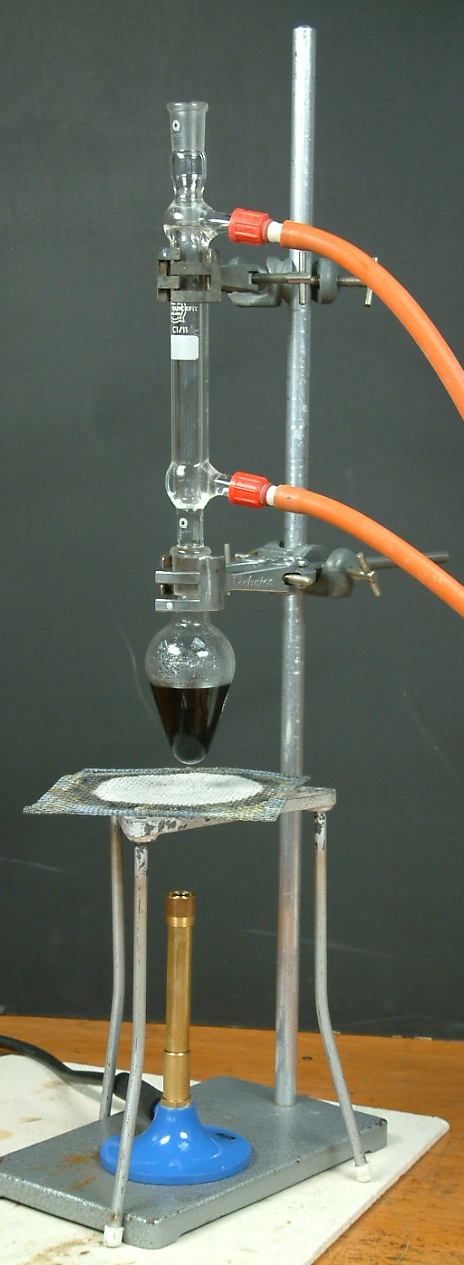
Many organic reactions are quite slow and need heating to achieve a reasonable reaction rate. However, most organic chemicals are quite volatile, and if heated they will evaporate and be lost. The solution to this problem is to heat the reaction mixture under reflux. This involves having the reaction mixture in a flask which is attached to a vertical, open Liebig condenser. Never attempt to stopper the Liebig condenser. This is quite a popular idea among students "to stop the vapour escaping". If you attempt to heat sealed glass apparatus it may explode! There should be no problem with vapour escaping - as it hits the cold surface of the condenser it will condense and drip back in to the flask. Look for this on the video. The use of a hot water bath may be safer and prevent overheating, but will limit the reaction temperature to 100 ºC. Clicking on the picture will give you a larger image. |
|
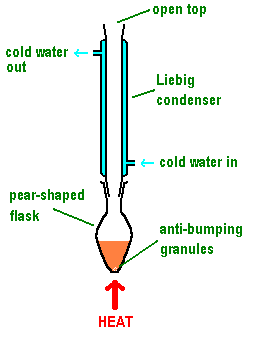
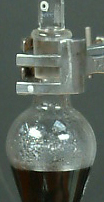
The flow of cold water through the condenser should be slow. Most students seem to think that a fast flow will be more efficient in cooling, but it makes little difference, and a fast flow usually leads to floods! If vapour is escaping from the top of your condenser reduce your rate of heating. Using a gauze over the Bunsen allows the mixture to boil more smoothly. It is a good idea to use a few anti-bumping granules in the boiling liquid. You may be asked to draw a diagram of this apparatus for your exam. You don't need to use colour in your diagram. |
|
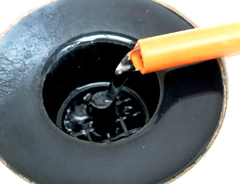
Water entering the condenser at the wrong end. It should enter at the bottom. If it enters at the top there are likely to be air pockets which result in poor condensation. See video.
|
|
Too fast a flow of water. This may result in flooding. |
No flow of water or Liebig condenser attached to the hot tap. Poor condensation.
|
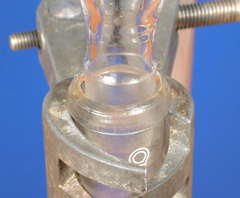
Loose or inadequate clamping. This may lead to later glassware breakage. Both the pear-shaped flask and the Liebig condenser should be clamped. The pear-shaped flask should be clamped firmly and just below the glass lip at the top. The Liebig condenser can be lightly clamped - its main purpose is to prevent the weight of the rubber tubing from twisting it over. |
|
Clamping too tight. The very expensive glassware breaks - you will not be popular!
Rubber tubing burns. The rubber tubing is in contact with the gauze or tripod. Use the clamp stand to direct the tubing clear of any hot areas.
|
|
Quickfit not sealing. Always check just prior to heating. The tightening of the clamps often leads to the Quickfit joint coming apart. Vapour will escape from your apparatus and yield will be reduced. There is a safety hazard from organic vapour escaping into the lab. The vapour may also catch fire resulting in another hazard. |
Failure to lightly grease the Quickfit joints. This leads to the apparatus being difficult to pull apart after use.
Excessive heating. This may cause the mixture to froth up the Liebig condenser. Remember that the Bunsen burner can be turned down at the gas tap.
Heating with yellow flame. Messy.
No tripod and gauze. The flask can be directly heated if the Bunsen is held and played across the flask so as not to overheat it. However, if the Bunsen is static the flask will overheat leading to bumping and charring. The gauze spreads the heat and reduces the probability of overheating. A few anti-bumping granules also encourage smooth boiling. The use of an electric heating mantle would be a safer alternative.