ISSR CLASSES
Checkpoint Science
iGCSE Chemistry
iGCSE Physics
iGCSE Coordinated Science
A-Level Chemistry
PRACTICALS
Practicals Home
Practicals A-Z
Study Plan for Practical Work
|
Hess's Law states that the total enthalpy change for a reaction is independent of the route taken between reactants and products. |
For example,
|
|
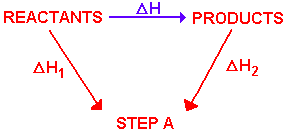
In this diagram DH represents the enthalpy change for the direct reaction, turning reactants into products. It also shows an alternative, two step process for the change from reactants to products, via step A. According to Hess's Law the total enthalpy change must be the same, so DH = DH1 + DH2 |
Another consequence of Hess's Law is that if we have an enthalpy change for a reaction and want to know the enthalpy change for the reverse reaction, we simply change the sign.
|
In this diagram, DH again represents the enthalpy change for the direct reaction, turning reactants into products. The alternative route is to go from reactants to step A (DH1) and then from step A to the products. We are given the enthalpy change for the reaction, products to step A (DH2), but we need the reverse change. We simply change the sign by inserting a negative sign, so this time DH = DH1 - DH2 |
|
Example
In "A" level practical work Hess's Law usually involves deciding on a "Hess's Law triangle". This enables us to find a way around a reaction for which we cannot measure the enthalpy change directly. For example, the thermal decomposition of potassium hydrogencarbonate:
|
2KHCO3(s) ⇒ K2CO3(s) + H2O(l) + CO2(g) |
This is an endothermic reaction, but it does not take place spontaneously so we can't just measure the temperature drop. It needs heating strongly to get the reaction to take place. Some of this heat is absorbed by the reaction and a lot escapes into the surroundings. So we can't do a simple plastic cup experiment and just watch the temperature drop. However, if we are told that both the reactant and products will react with dilute hydrochloric acid to make the same substances, we can construct a Hess's Law triangle. On the top line we have the reaction we are trying to find the enthalpy change for. Going down from this to the bottom tip of the triangle should be two practical reactions:
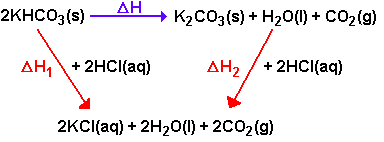
The energy changes represented by DH1 and DH2 are easily measured using plastic cup experiments. Using Hess's Law we just take a longer route between the reactants (2KHCO3(s)) and products (K2CO3(s) + H2O(l) + CO2(g)), but the overall enthalpy change is the same. We need to follow the left hand arrow (DH1) from the reactants and then go backwards up the right hand arrow (this makes it - DH2) to get to the products. Put mathematically, DH = DH1 - DH2. Note that in this cycle DH1 is the value for 2KHCO3 and DH2 is the value for just one K2CO3. Some students prefer this alternative method.
It is important that the reactions which give the enthalpy changes DH1 and DH2 are practical reactions which can be carried out in the plastic cup. Students have a habit of putting the elements at the bottom of the triangle and making the reactants and products from them. This is the basis of working out an enthalpy change from enthalpies of formation. This is a theoretical method which uses values from the data book - it is not practical. In the above example, it would be completely impractical to try and make the various chemicals from potassium metal, chlorine, hydrogen and oxygen gases and carbon, all added to our plastic cup! Do not use the elements for the bottom tip of the Hess's Law triangle for a practical experiment.
Exercise 1
Draw out a Hess's Law triangle in order to provide a method of measuring the following enthalpy change:
|
CuSO4(s) + 5H2O(l) ⇒ CuSO4.5H2O(s) |
It is not possible to measure this change directly. Both reactant and product are soluble in water forming the same solution. Give details of the practical work you would carry out. You can check your answer here.
Exercise 2
This exercise is interesting as you will have to be careful with the numbers of moles. We are looking to find the enthalpy change for the following reaction:
|
2NaHCO3(aq) + CaCl2(aq) ⇒ CaCO3(s) + 2NaCl(aq) + H2O(l) + CO2(g) |
We have carried out the following two reactions and obtained enthalpy change values for them:
|
NaHCO3(aq) + HCl(aq) ⇒ NaCl(aq) + H2O(l) + CO2(g) |
DH1 |
|
CaCO3(s) + 2HCl(aq) ⇒ CaCl2(aq) + H2O(l) + CO2(g) |
DH2 |
Use Hess's Law to determine what combination of the two enthalpy change values will give the enthalpy change for the reaction required.
Exercise 3
A final challenge! In this exercise we have three measured enthalpy changes from which we can calculate the DH value of the unmeasured change by applying Hess's Law. Try using the technique in exercise 2 to evaluate the enthalpy change for:
|
Ca(s) + ½O2(g) ⇒ CaO(s) |
We have carried out the following three reactions and obtained enthalpy change values (all in kJ mol-1) for them:
|
Ca(s) + 2H+(aq) ⇒ Ca2+(aq) + H2(g) |
DH1 = - 543 |
|
2H2(g) + O2(g) ⇒ 2H2O(l) |
DH2 = - 572 |
|
CaO(s) + 2H+(aq) ⇒ Ca2+(aq) + H2O(l) |
DH3 = - 194 |