ISSR CLASSES
Checkpoint Science
iGCSE Chemistry
iGCSE Physics
iGCSE Coordinated Science
A-Level Chemistry
PRACTICALS
Practicals Home
Practicals A-Z
Study Plan for Practical Work
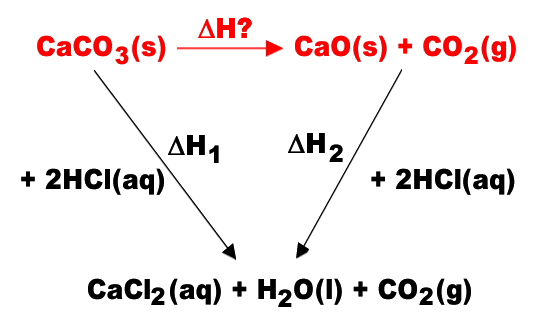
In this experiment we shall use simple insulated cup calorimetry to measure the enthalpy changes for two simple reactions. This will allow us to construct a Hess's Law triangle to calculate the enthalpy change for a thermal decomposition reaction which it is not possible to measure directly:
Mass of CaCO3 = 1.987 g
Temperature change = 26 - 23 = 3 ºC
Mass of water = 25 g (assuming the acid is largely water of density 1 g cm-3)
Specific heat capacity of water = 4.2 J g-1 K-1
Heat evolved = 25 × 4.2 × 3 = 315 J = 0.315 kJ
CaCO3 = 100
Number of moles of CaCO3 = 1.987/100 = 0.01987 mol
DH1 = 0.315/0.01987 = - 15.9 kJ mol-1
Mass of CaO = 1.028 g
Temperature change = 53.5 - 23 = 30.5 ºC
Mass of water = 25 g (assuming the acid is largely water of density 1 g cm-3)
Specific heat capacity of water = 4.2 J g-1 K-1
Heat evolved = 25 × 4.2 × 30.5 = 3202.5 J = 3.203 kJ
CaO = 56
Number of moles of CaO = 1.028/56 = 0.01836 mol
DH2 = 3.203/0.01836 = - 174 kJ mol-1
DH? = DH1 - DH2 = - 15.9 - - 174 = + 159 kJ mol-1
The accepted value is + 178 kJ mol-1