ISSR CLASSES
Checkpoint Science
iGCSE Chemistry
iGCSE Physics
iGCSE Coordinated Science
A-Level Chemistry
PRACTICALS
Practicals Home
Practicals A-Z
Study Plan for Practical Work
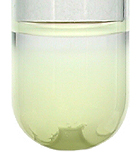
Iodoform (compare chloroform, the anaesthetic) is the old name for tri-iodomethane, CHI3. It is an easily recognized yellow, crystalline solid.
|
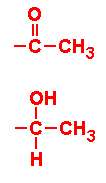
It is formed when compounds containing a methyl group next to an alcohol or carbonyl group are treated with sodium hydroxide solution and iodine. Hence, the appearance of the yellow iodoform precipitate is used as a test for these groups. A positive iodoform test shows a methyl carbonyl or a methyl secondary alcohol or ethanol. For example, ethanol, ethanal, propan-2-ol and propanone. |
|
Iodine is an oxidizing agent. If one of the above alcohols is used, it is first oxidized to the carbonyl group. The following reaction then produces the iodoform:
|
RCOCH3(aq) + 3I2(aq) + 4NaOH(aq) ⇒ RCOONa(aq) + 3H2O(l) + 3NaI(aq) + CHI3(s) |
|
|
In the following video a few drops of propanone were added to a few cm3 of 0.5 M sodium hydroxide solution. Iodine solution is then added to the mixture: |