ISSR CLASSES
Checkpoint Science
iGCSE Chemistry
iGCSE Physics
iGCSE Coordinated Science
A-Level Chemistry
PRACTICALS
Practicals Home
Practicals A-Z
Study Plan for Practical Work
We need to use the correct formulae throughout the practical and theory work of chemistry. They are the language of chemistry and it is important to get them right.
Ionic compounds are generally formed between metals and non-metals. Most elements are metals (shown in yellow below). The non-metals can be found on the right hand side of the periodic table (in purple below). Those marked in green are metalloids with properties in between metals and non-metals.
|
|
The metal atom loses its outer electron(s) to become a positive ion or cation. The non-metal gains electrons to become a negative ion or anion. The resulting attraction between the positive and negative ions holds the compound together (opposite charges attract). A typical example is salt which is sodium chloride:
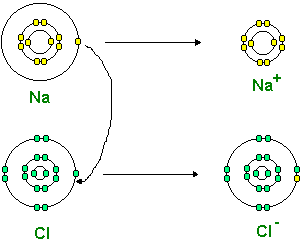
Salt has high melting and boiling points as the ions attract each other strongly and are hard to separate. As the ions are charged, if they become free to move it will conduct electricity - this happens if the salt is melted or dissolved in water. Salt dissolves in water because the polar water molecules are attracted to the charged ions. This behaviour is typical of an ionic compound. They have high melting points, conduct when molten or in solution, and tend to dissolve in polar solvents, like water, rather than non-polar solvents like petrol. Evidence for this ionic model is seen in this demonstration, where a voltage applied across a sample of potassium manganate(VII) causes the purple MnO4- ion to move towards the positive electrode (opposites attract).
It is very important to be able to work out the formula of an ionic compound. In order to do this you will need to learn the name and formula of the following ions (try making some flash cards):
|
Lithium |
Li+ |
Chloride |
Cl- |
|
Sodium |
Na+ |
Bromide |
Br- |
|
Potassium |
K+ |
Iodide |
I- |
|
Hydrogen |
H+ |
Hydrogencarbonate |
|
|
Ammonium |
|
Hydroxide |
OH- |
|
Silver |
Ag+ |
Nitrate |
|
|
Magnesium |
Mg2+ |
Manganate(VII) |
|
|
Calcium |
Ca2+ |
Oxide |
O2- |
|
Barium |
Ba2+ |
Sulfide |
S2- |
|
Zinc |
Zn2+ |
Sulfate |
|
|
Aluminium |
Al3+ |
Carbonate |
|
|
Fluoride |
F- |
Dichromate(VI) |
|
There are some patterns which make learning easier. All group 1 atoms form 1+ ions, all group 2 form 2+ ions, all group 3 form 3+ ions, all group 7 form 1- ions, all group 6 form 2- ions and all group 5 form 3- ions. Some atoms are able to form more than one ion, the charge of the particular ion is given in Roman numerals in brackets after the name. So iron(III) contains Fe3+ and iron(II) contains Fe2+. Some compounds are so common their formulae are worth memorizing - eg water, H2O; carbon dioxide, CO2; hydrochloric acid, HCl; sulfuric acid, H2SO4; and nitric acid, HNO3.
In order to work out the formula of a compound, a positive ion is placed with a negative ion. The number of ions is then adjusted until the positive charge exactly balances the negative charge. For example:
Sodium chloride Na+ and Cl- formula NaCl
one 1+ ion balances one 1- ion.
Calcium oxide Ca2+ and O2- formula CaO
one 2+ ion balances one 2- ion.
Magnesium bromide Mg2+ and Br- formula MgBr2
one 2+ ion balances two 1- ions.
Aluminium oxide Al3+ and O2- formula Al2O3
two 3+ ions balance three 2- ions.
Iron(III) chloride Fe3+ and Cl- formula FeCl3
one 3+ ion balance three 1- ions.
Copper(II) hydroxide Cu2+ and OH- formula Cu(OH)2
one 2+ ion balances two 1- ions. (Note the use of brackets - this shows that there are two OH- ions. Without the brackets it would mean one O and two Hs)
Ammonium sulfate NH4+ and SO42- formula (NH4)2SO4
two 1+ ions balances one 2- ion.
(Note NH4+ means NH4 with a 1+ charge not NH with a 4+ charge.)
Try the computer program FORMULA (if you press the # key at any time you will get a wider range of ions).


