ISSR CLASSES
Checkpoint Science
iGCSE Chemistry
iGCSE Physics
iGCSE Coordinated Science
A-Level Chemistry
PRACTICALS
Practicals Home
Practicals A-Z
Study Plan for Practical Work
The first obvious benefit is that you can (and do!) lose marks in assessments for poor labeling.
Good labeling helps others to understand your work more clearly. If, in due course, you are writing a scientific paper or a report for your employer, it is important that others can understand your working. Less obvious, maybe, is that clear labels make it more likely that you will understand your own work and get the correct final answer.
|
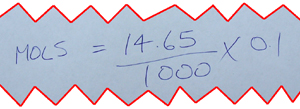
I often read assessment work like this: |
|
Sometimes, even less helpfully, I'm not even told it's a number of moles! In some cases there may be credit for this particular part of the calculation - but only if we are told what it represents. A correct label may read as follows:
Number of moles of HCl in 10.0 cm3 = 14.65/1000 × 0.100
You might have spotted that there was a sig. fig. error as well! I now know what the calculation refers to - hydrochloric acid. I may be involved in further calculation involving the other chemical in this reaction. It will help me to get the next stage correct if I am clear in my mind which of the two chemicals the first calculation refers too. It also clearly shows that this is the amount of hydrochloric acid in 10.0 cm3 (probably a pipette volume). If I need to work out the concentration (that is the number of moles in 1000 cm3), I should be able to see that this is not the final answer. It may even remind me how to calculate this stage - I could multiply the answer by 100 to get the concentration (10 × 100 = 1000).