ISSR CLASSES
Checkpoint Science
iGCSE Chemistry
iGCSE Physics
iGCSE Coordinated Science
A-Level Chemistry
PRACTICALS
Practicals Home
Practicals A-Z
Study Plan for Practical Work
|
|
To understand logs we need to understand the work on powers that we saw in the last section. The log of a number is the power the base has to be raised to in order to give the original number. An example should make this clearer: |
log101000
To get 1000 we have to raise 10 (the base) to the power 3 as 103 = 1000
Consequently, log101000 = 3
log100.01
To get 0.01 we have to raise 10 (the base) to the power -2 as 10-2 = 0.01
Consequently, log100.01 = -2
To reverse the process of taking a log of a number we have to raise the base to the log. In the example given above, where log10 = 3, the original number must be 103 = 1000.
Natural logs use the base e (a number approximately equal to 2.7182). This number is chosen for mathematical reasons. The principle behind natural logs is exactly the same as that for the base 10 logs.
|
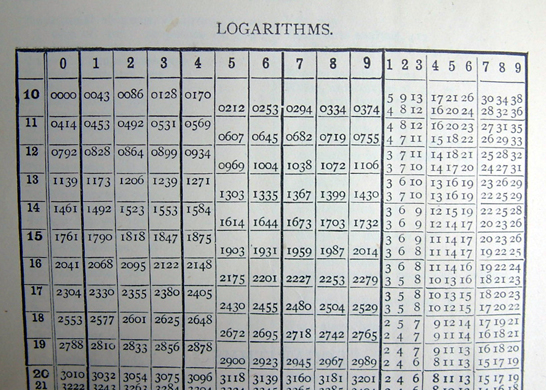
Logs have the useful property that adding them together has the effect of multiplying together the original numbers. Consequently, logs were used before the existence of calculators for multiplying numbers together, as adding is easier than multiplying. The logs were read from books of log tables which also gave tables for reversing the log process in order to recover the result for the multiplied numbers. |
|
ln(x) is directly proportional to log10(x), the conversion factor being ln(10), which is approximately 2.303. So ln(x) = 2.303 × log10(x). As all modern scientific calculators have both log10 and ln functions this seems of little value, but some specifications still make use of it.