ISSR CLASSES
Checkpoint Science
iGCSE Chemistry
iGCSE Physics
iGCSE Coordinated Science
A-Level Chemistry
PRACTICALS
Practicals Home
Practicals A-Z
Study Plan for Practical Work
|
You may have met this technique in secondary school, or even primary school, to separate the colours in felt tip pen ink. Black ink often separates well into a variety of colours. The name comes from the Greek, chroma, meaning colour. However, the materials being separated do not need to be coloured. |
|
|
|
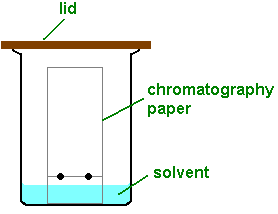
In this technique, a pencil line is placed about 1 cm from the bottom of some chromatography paper. Chromatography paper is absorbent, like blotting paper. A small spot of the solution being examined is placed on the line, and labelled at the top of the paper. The paper is then placed in a container which has a small amount of solvent at the bottom. It is important that the solvent does not cover the spots of solution placed near the base of the paper. Otherwise they will simply dissolve in the solvent and spread over all the paper. |
A top is placed on the container, and it is left for a period of time to allow the solvent to rise up the paper to a little short of the top. The paper is then removed and the solvent front marked on. If the original solution contained a mixture of materials these may rise to different heights and be separated. If these materials are coloured this will be visible on the paper. If they are not coloured they will have to be developed using a chemical which gives a visible stain. A single spot would suggest that the original material was a pure substance.
There are a number of types of chromatography. In each, there is a stationary phase and a moving phase. In the case of paper chromatography, the paper is the stationary phase and the solvent is the moving phase. The solvent rises up the paper. When it reaches the solution spots, they will also rise up. Depending on how well the material adheres to the paper compared to how well it dissolves in the solvent, the spots rise up at different rates and will end up in different positions.
A top placed on the chromatography container keeps the vapour surrounding the paper. This prevents it from drying out and the solvent will continue to rise up the paper.
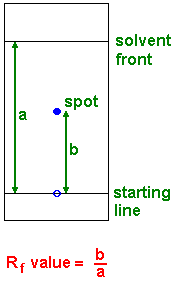
It is important to use only small spots of solution. Larger drops produce chromatograms with large splotches, and it is difficult to measure the Rf value. It is better to produce a small spot and allow it to dry (a hairdryer helps here!) and then repeat the spotting procedure.
Try the chromatogram analysis exercise.