ISSR CLASSES
Checkpoint Science
iGCSE Chemistry
iGCSE Physics
iGCSE Coordinated Science
A-Level Chemistry
PRACTICALS
Practicals Home
Practicals A-Z
Study Plan for Practical Work
1 Preparation of poly(phenylethene)
This is an example of addition polymerization, common in molecules containing a carbon-carbon double bond. The following equation shows the formation of the polymer chain:

The bulky side chains restrict the movement of these polymer chains over each other. Consequently, this polymer tends to be more rigid than a polymer like poly(ethene).
2 The "nylon rope trick"
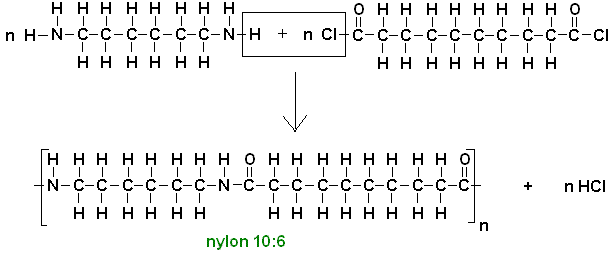
There are a number of different nylon polymers, but they are all condensation polymers. This can be seen from the equation, where HCl is lost from the reactants on forming the polymer chain. In this experiment we make nylon 10:6 by the reaction between decanedioyl dichloride (which has 10 carbon atoms) and 1,6-diaminohexane (which has 6):
3 The preparation of a polyester resin
This reaction produces another condensation polymer as can be seen from the water molecule which is lost from the reactants:

This equation only shows three molecules reacting, but there is the opportunity for extensive cross-linking between the remaining OH groups and other benzene-1,2-dicarboxylic anhydride molecules. You should be able to recognize the ester linkages which have been formed.
4 The preparation of a cross-linked polymer
The hydrogen bonds between the polymer chains and the borate ions are relatively easily broken. This explains some of the unusual properties of slime.