ISSR CLASSES
Checkpoint Science
iGCSE Chemistry
iGCSE Physics
iGCSE Coordinated Science
A-Level Chemistry
PRACTICALS
Practicals Home
Practicals A-Z
Study Plan for Practical Work
NMR stands for nuclear magnetic resonance. This technique relies on the fact that certain nuclei behave like tiny magnets. The 1H atom and 13C are the most commonly studied. We shall only be looking at 1H NMR, otherwise known as proton NMR. If a sample of compound containing hydrogen atoms (most organic compounds) is placed in an extremely strong magnetic field, the tiny nuclear magnets can be made to flip over by applying radio frequency energy to them. The exact amount of energy required depends on the local environment of the hydrogen atoms concerned. The energies absorbed by a sample are plotted on a spectrum, and analysis of this reveals a lot of detail about the compound concerned. As with the other instrumental techniques, proper analysis of the spectra is complicated, but a simple interpretation can still tell us a lot about an unknown sample.
At its simplest, we can use the technique to tell us how many different hydrogen atom environments exist within the molecule. This may well be enough to distinguish it from other isomers, and do the work necessary to answer an exam question. It is important that you can distinguish the different environments, so we'll start with an example:
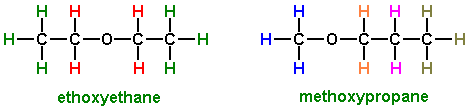
In ethoxyethane there are only two different environments. You should see a high degree of symmetry. The four hydrogen atoms attached to the carbons directly attached to the oxygen atom are all equivalent. Similarly, the six in the end methyl groups are all equivalent. In methoxypropane there are now four different environments. The methyl group hydrogen atoms are no longer equivalent, as one is directly attached to the oxygen atom and the other is further away. The two CH2 group (methylene group) are also different as one is directly attached to the oxygen atom and the other is further away.
Exercise
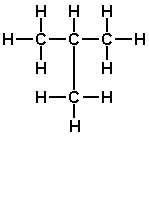
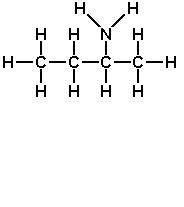
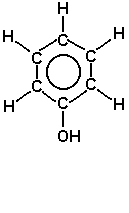
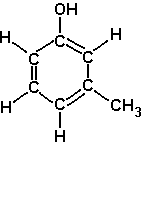
Work out how many different hydrogen environments each of the following molecules has. You can check by clicking on the molecule:
 |
 |
 |
 |
The spectrum may have been integrated. This uses a machine to calculate the area under each peak. This area depends on the number of hydrogen atoms which are responsible for it. Consequently, we can work out the number of hydrogen atoms represented by each peak.
The nmr spectrometer is calibrated with a chemical called tetramethylsilane or TMS. All the hydrogen atoms have the same environment in this compound, so only one peak occurs. This occurs at d0 (the scale is marked d and the units are ppm -parts per million). Ignore any peak at d0, it is the calibration sample.
The exact position that a peak occurs on the spectrum depends on the environment of the hydrogen atoms concerned. In a similar way to that used in the infra-red spectra, we can correlate the observed peaks with known ones from the data book.
You will notice when we look at a real spectrum, that the peaks are not always single absorptions (known as singlets). There may be two adjacent absorptions (a doublet), or three (a triplet), or four (a quartet) or more (a multiplet). This is because the environment of each hydrogen atom is affected by its immediate neighbours - an effect known as spin-spin coupling. The absorptions are said to be split. Look at the carbon to which the hydrogen atom(s) of one environment is/are attached. Count up the number of hydrogen atoms attached to the adjacent carbon atom(s). Add one. This will be the number of peaks you see on the spectrum. Some exam boards give spectra which only show singlets - these are known as a low resolution spectra.
Example
|
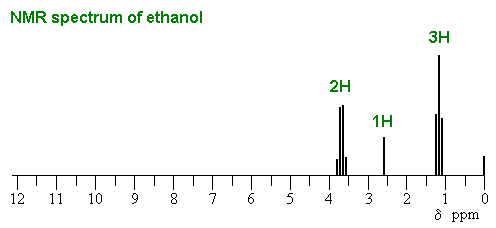
This spectrum has a TMS peak at d0 and three other peaks. There is a triplet at d1.2, a singlet at d2.6 and a quartet at d3.7. The H attached to the oxygen behaves as if it has no neighbours, so gives the singlet at d2.6. Checking a data book confirms that an OH hydrogen would appear in this region of the spectrum. The three methyl hydrogen atoms have two hydrogen neighbours on the adjacent carbon, so appear as a triplet (2 + 1). Again the data book confirms d1.2 as the correct region of the spectrum for a methyl, alkane-like group. Finally, the two methylene hydrogens appear as a quartet (3 + 1) as they have three hydrogen atom neighbours on the adjacent carbon atom. Being attached to the oxygen has shifted the peak up the spectrum and it appears at d3.7. This agrees with the data book, appearing as H-C-O, alcohol. |
You can find some example problems in the spectroscopic analysis section.