ISSR CLASSES
Checkpoint Science
iGCSE Chemistry
iGCSE Physics
iGCSE Coordinated Science
A-Level Chemistry
PRACTICALS
Practicals Home
Practicals A-Z
Study Plan for Practical Work
In this method we treat the equation like a recipe. We add up the masses for the numbers of moles shown in the equation. The masses we get may not be the masses we want to use. So we scale up or down the quantities from the equation to give the quantities we want. Just as in a recipe, if we multiply or divide all of the ingredient quantities by the same number, they will still be in the correct ratio.
All the following examples and exercises assume that the reaction proceeds with 100% yield.
Example 1
What mass of iron reacts with 10.0 g of sulfur? [Fe = 56, S = 32]
First we need the correctly balanced equation with the correct molar masses:
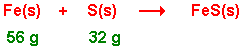
The equation shows that 32 grams of sulfur reacts with 56 grams of iron. We only have 10 grams of sulfur. This is around a third of the quantity given in the equation so we should need around a third of the 56 grams of iron shown. We can work out the exact mass in two stages. We need to turn the 32 g into 10 g. First, divide both masses by 32 (32/32 = 1) to find out how much iron reacts with 1 gram of sulfur:
Mass of iron which reacts with 1 g of sulfur = 56/32 g
Then multiply both masses by 10.0 (1 × 10.0 = 10.0) to find out how much iron reacts with 10.0 grams of sulfur:
Mass of iron which reacts with 10.0 g of sulfur = 56/32 × 10.0 = 17.5 g
Example 2
What mass of magnesium oxide is made when 250 g of oxygen reacts with excess magnesium? It is important to have an excess of magnesium so that all of the oxygen reacts. [Mg =24, O =16].

The equation shows that 32 grams of oxygen produce 80 grams of magnesium oxide. We need to scale up the 32 grams of oxygen to 250 grams (it is roughly 8 times as much, and we could use this to estimate the answer). First divide both masses by 32 (32/32 = 1):
Mass of magnesium oxide produced from 1 g of oxygen = 80/32 g
Then multiply both masses by 250 (1 × 250 = 250)
Mass of magnesium oxide produced from 250 g of oxygen = 80/32 × 250 = 625 g
1. In the reduction of copper(II) oxide to copper, what mass of copper(II) oxide is needed to produce 100 g of copper?
2. In the dehydration of butan-1-ol to but-1-ene, what mass of but-1-ene is produced from 8.9 g of butan-1-ol?