ISSR CLASSES
Checkpoint Science
iGCSE Chemistry
iGCSE Physics
iGCSE Coordinated Science
A-Level Chemistry
PRACTICALS
Practicals Home
Practicals A-Z
Study Plan for Practical Work
The halogens usually react readily with metals to form halides. An example being the formation of sodium chloride:
|
2Na(s) + Cl2(g) ⇒ 2NaCl(s) |
The halogens react with solutions of alkali (usually sodium hydroxide or potassium hydroxide solution). This can be seen when iodine or bromine is added to a solution of alkali as the colour of the halogen disappears:
Video - the reaction of halogens with cold alkali
It is an interesting reaction, as the products depend on the conditions under which it is carried out. At room temperature the following general reaction takes place:
|
X2(aq) + 2OH-(aq) ⇒ X-(aq) + XO-(aq) + H2O(l) |
This is an ionic equation in which we have missed out the spectator ions (probably sodium or potassium ions). X represents the halogen (that is Cl, Br or I). We can write down the equation for a specific reaction, like the one between chlorine water and sodium hydroxide solution:
|
Cl2(aq) + 2NaOH(aq) ⇒ NaCl(aq) + NaClO(aq) + H2O(l) |
Try to write equations for the reactions of bromine with sodium hydroxide solution and chlorine with potassium hydroxide solution. Check your answers here.
The XO- ion is a halate(I) ion (chlorate(I), bromate(I) or iodate(I)). With the oxygen in its usual oxidation state of -2, the halogen must be in an oxidation state of +1. This makes this an interesting redox reaction. The halogen, X2, is an element and so has an oxidation state of zero (all elements are zero). The halide ion, X-, has an oxidation state of -1. This means that in this reaction, the halogen (oxidation number 0) has increased to +1 (the halate(I) ion) and decreased to -1 (the halide ion).
A reaction in which the same element both increases and decreases in oxidation number is called a disproportionation reaction.
In most redox reactions one element increases in oxidation number (is oxidized) and a different element decreases in oxidation number (is reduced).
If the reaction is carried out with hot solutions (over 60ºC) a different product is obtained. The general reaction is:
|
3X2(aq) + 6OH-(aq) ⇒ 5X-(aq) + XO3-(aq) + 3H2O(l) |
For example, the reaction between bromine and potassium hydroxide at 60ºC:
|
3Br2(aq) + 6KOH(aq) ⇒ 5KBr(aq) + KBrO3(aq) + 3H2O(l) |
The XO3- ion is a halate(V) ion (chlorate(V), bromate(V) or iodate(V)). With the oxygen in its usual oxidation state of -2, the halogen must be in an oxidation state of +5. You should see that this is another example of a disproportionation reaction. The halogen element (oxidation state 0) has both risen to +5 (the halate(V) ion) and fallen to -1 (the halide ion).
Spotting a disproportionation reaction is a popular activity on the exam. Try to spot which of the following two reactions is a disproportionation reaction (click on the right answer):
 |
 |
Uses of the halogens and their compounds
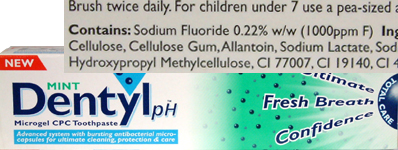
Fluorine is extremely reactive and has few uses as an element. Sodium fluoride is used in fluoride toothpastes to strengthen enamel. The compound polytetrafluoroethene (PTFE) is used in non-stick surfaces like those on frying pans.
Chlorine is used to disinfect swimming pools and drinking water. Polyvinyl chloride (PVC) is an important plastic used, among other things, for doors and windows. Sodium chloride is well known as salt, and we have used sodium chlorate(I) in practical - it is found in bleach. Sodium chlorate(V) is a powerful weed-killer.
Bromine is a very corrosive liquid. It also has few direct uses as an element. Potassium bromide is used as a sedative.
Iodine is an important antiseptic. It is found in some medicine cabinets, and may be swabbed over large areas of skin in operations. Potassium iodide is sometimes added to salt as a source of iodine. Lack of iodine in the diet leads to the disease, goitre.