ISSR CLASSES
Checkpoint Science
iGCSE Chemistry
iGCSE Physics
iGCSE Coordinated Science
A-Level Chemistry
PRACTICALS
Practicals Home
Practicals A-Z
Study Plan for Practical Work
The number of significant figures (or sig. figs.) is the number of figures in a number except leading zeros. A few examples should make this clear:
|
Number |
sig. figs. |
*There is some ambiguity with zeros on the right, which do not follow the decimal point. Technically, 12000 is 5 significant figures - we mean that it is 12000, not 12001. However, we might have taken a number like 12134 and rounded it to the nearest thousand. In this case it is only 2 significant figures. If only 2 sig. figs. are required, it would be better expressed as 1.2 × 10⁴. |
|
|
42.317 |
5 |
||
|
25 |
2 |
||
|
0.846 |
3 |
||
|
25.0 |
3 |
||
|
0.00388 |
3 |
||
|
12000 |
5* |
||
|
3.130 × 10⁶ |
4 |
|
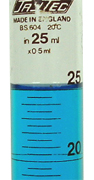
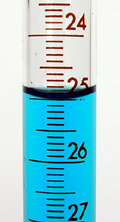
25 and 25.0 may appear to be the same number, but in a practical situation they are not. The 0 in 25.0 is significant. We mean that the number is not 25.1 or 24.9. We might be dealing with a volume measurement. In the case of the 25 we might have measured the volume to the nearest half cubic centimetre using a measuring cylinder. By giving the answer as 25 cm3 we are showing that the closest measurement we have is 25 cm3. However, the real value could be 25.3 cm3. If we had made a more accurate measurement with a burette, we would have stated the answer as 25.0 cm3 showing that the value was not 24.9 cm3 or 25.1 cm3. Consequently, the number of significant figures that we give for an answer gives an indication of the accuracy of that answer. |
|
|
|
A measurement of 25.0 cm3 could be up to 0.05 out. This means that our measurement is accurate to 1 part in 500 . You cannot have a final answer to a calculation which is more accurate than the measurements from which it was calculated. Students often manage to calculate answers like 514.7662 from an original measurement like that above. This answer has a stated accuracy of 1 in over 10 million . This is impossible from the original data, all the figures after the decimal point are quite meaningless. We could calculate the accuracy of all the measurements and the final answer, as we have done above, and make sure they match. However, as a general rule, your final answer should be given to the same number of significant figures as the least accurate measurement from which it was calculated. You have to use your judgment here, though, as some questions are not always precisely worded. It may state that a solution was made up to 1 dm3. This is only 1 significant figure, but it is highly unlikely that the solution is up to ½ dm3 out. The question should probably have said 1.000 dm3, and it would be valid to use more than 1 sig. fig. in your final answer. |
|
Bear in mind, that few of our experiments are more accurate than 1% or 1 part in 100! So if you are giving an answer to one of your own experiments avoid putting down too may significant figures. |
|
In some exam situations you will be told to give your answer to a given number of significant figures. This should be easy if you understand significant figures, but students often do not follow the instructions given! Make sure you round your answer to the nearest number, rather than just chopping off the end figures. Try to state the following numbers to the required number of significant figures and check your answers by clicking on ANSWER:
|
Number |
Required sig. figs. |
Answer |
|
22.177 |
4 |
|
|
0.003184 |
3 |
|
|
782541 |
2 |
|
|
2.997503 × 10⁻⁵ |
4 |
|
|
0.3146 |
2 |
|
|
4.9986 |
3 |
|
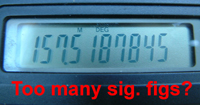
Always avoid writing down the complete display on your calculator. It is highly unlikely that all the figures will be significant. One problem that can still arise is a rounding error. If all your original data is given to three sig. figs. we should generally also express our final answer to three sig. figs. However, if you use the same number of figures for any intermediate answers, this may result in an error in the final answer. The best solution is to use the complete number of figures throughout in your calculator. An example makes this easier to see:
Calculate 1.38 divided by 128. Give your answer to the same three sig. figs. we started with.
Now divide 2.66 by the previous answer. Express your answer to three sig. figs.
Now do the whole calculation in one go in your calculator. Express your answer to three sig. figs.
Check your answers here.
You should have found that the two answers were different. They can't both be right. The problem with rounding the intermediate answer is that rounding (particularly repeated rounding) can create an error in the final answer. So don't write down too many sig. figs., but do use all the figures in your calculations.