ISSR CLASSES
Checkpoint Science
iGCSE Chemistry
iGCSE Physics
iGCSE Coordinated Science
A-Level Chemistry
PRACTICALS
Practicals Home
Practicals A-Z
Study Plan for Practical Work
Stock notation uses the oxidation number of an element to identify a particular compound where there is more than one possible oxidation number. Sodium always has the oxidation number +1, so it would be pointless to describe sodium chloride as sodium(I) chloride. There is only one sodium chloride and the sodium must be in oxidation state +1.
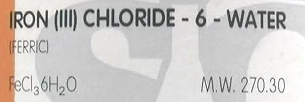
However, with iron chloride there are two common oxidation states (numbers) of the iron, leading to two different iron chlorides, each with a different formula. If you were to ask a chemist for some iron chloride, they would reply, "Which one?". In this case it is important to state the oxidation number of the iron when giving the name. Iron(II) chloride is FeCl2 and iron(III) chloride is FeCl3. Note that Stock notation is only used in the written name and not in the formula - in FeCl3 the iron must be in oxidation state +3 in order to match up with the three chlorines so it is not written Fe(III)Cl3.
|
Students usually have most difficulty in distinguishing between an oxide and an oxy-anion. We have met oxides before, they have two elements in them and they are uncharged (there is no charge on the formula). Copper forms two oxides. Cu2O is copper(I) oxide (it is red), and CuO is copper(II) oxide (it is black). |
|
|
|
However, if there is a charge on the formula we are dealing with an ion. A negatively charged ion containing oxygen is called an oxy-anion, and the name always ends -ATE. We have met a number of these before. SO42- is the sulfate ion. Technically, we should include the oxidation number and call it the sulfate(VI) ion, but this is often left out. There is also SO32-, which is the sulfate(IV) ion. You have to know (or guess!) the first part of the name which is based on the element other than oxygen. Nitrate, phosphate, carbonate, chromate, manganate, silicate, chlorate, bromate, iodate, bismuthate are some common ones. |
A compound like NaBiO3 is not an oxide - even though you can see no charge. Remember, the Na is the Na+ ion, so the other ion is BiO3-. The Stock notation name is sodium bismuthate(V). A common error is to say sodium(V) bismuthate, but it is not the sodium which is in a +5 oxidation state, it is the bismuth. The oxidation number must always immediately follow the element to which it refers, and is written in Roman numerals.
|
|
Finally, you may meet some acids. The clue to these is the presence of hydrogen. You should always remember the really well known ones. So H2SO4 is sulfuric(VI) acid, but as this is the most common oxidation state the number is nearly always left out. However, this could lead to confusion as there is also a sulfuric(IV) acid, H2SO3, which used to be called sulfurous acid |
.
The best way to find out whether you understand this is to try plenty of examples. You will find them here.