ISSR CLASSES
Checkpoint Science
iGCSE Chemistry
iGCSE Physics
iGCSE Coordinated Science
A-Level Chemistry
PRACTICALS
Practicals Home
Practicals A-Z
Study Plan for Practical Work
Strong and weak acids
|
|
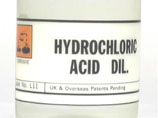
A strong acid, like hydrochloric acid, is virtually completely ionised in dilute solution. So in a 0.1 M solution of this acid (a dilute solution) we find that for every 1000 acid molecules we started with, all of them have ionised: |
|||||
|
HCl(aq) |
⇒ |
H+(aq) |
+ |
Cl-(aq) |
||
|
0 |
1000 |
1000 |
particles in solution |
|||
It is the hydrogen ion that causes all the acidic properties. Consequently, strong acids have strongly acidic properties as they have relatively high concentrations of hydrogen ions.
An alternative word for this ionization process is dissociation.
|
|
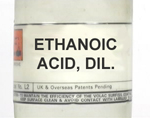
A weak acid, like ethanoic acid (found in vinegar), is only partially ionised in solution. In the same 0.1 M solution out of 1000 ethanoic acid molecules only 13 are ionised. 987 are not broken up. This gives a very low hydrogen ion concentration and therefore only weakly acidic properties: |
||||
|
CH3COOH(aq) |
⇒ |
H+(aq) |
+ |
CH3COO-(aq) |
|
|
987 |
13 |
13 |
|||
|
You need to be sure that you do not confuse the strength of an acid with the concentration of the acid. The concentration is a measure of the number of particles in a given volume of solution. The pH of an acid solution depends on both the concentration and the strength of the acid. |
|
It tends to be assumed that concentrated acid is bound to be very hazardous. However, the acidity depends on the acid strength. A concentrated solution of ascorbic acid (vitamin C) can be drunk without harm as the acid is weak. Consequently, whilst there is a high concentration of the original undissociated acid, there is a low concentration of hydrogen ions. However, don't always assumed that a weak acid is without risk. It may not be corrosive, but it could be toxic. Concentrated ethanoic acid does not have a particularly low pH, but it is an excellent protein solvent. It causes severe eye damage.
It is also possible to have a solution of a strong acid (like sulfuric acid) which is virtually neutral. We just have to make it very dilute. If the original acid is very low in concentration then, even if it all ionizes, there will still be a low concentration of hydrogen ions.