ISSR CLASSES
Checkpoint Science
iGCSE Chemistry
iGCSE Physics
iGCSE Coordinated Science
A-Level Chemistry
PRACTICALS
Practicals Home
Practicals A-Z
Study Plan for Practical Work
Bromination
Methoxybenzene reacts rapidly with bromine generating fumes of hydrogen bromide. This is tested for by the white fumes formed in the presence of ammonia gas. The arene reacts by substitution with one of the hydrogen atoms being replaced by a bromine atom. There are a number of hydrogen atoms which could be replaced leading to a number of possible isomers. You are not expected to know which particular atoms are most likely to be replaced, but you might want to research this for your own interest.
|
|
This reaction illustrates the increased reactivity of methoxybenzene due to the electron releasing property of the methoxy group. The oxygen atom in the methoxy group is adjacent to the benzene ring and its lone pair of electrons becomes delocalised in the ring. This increases the electron density and makes the ring more attractive to attack by electrophiles. The electrophile here is Brd+
Further substitution of the benzene ring is possible producing dibromomethoxybenzene and tribromomethoxybenzene.
Sulfonation
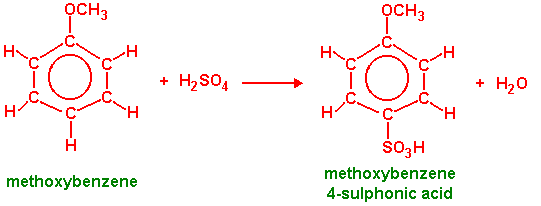
There is a reaction between concentrated sulfuric and methoxybenzene, again illustrating its increased reactivity compared to methylbenzene or benzene itself. The liquids mix, there is a temperature rise and a change in colour. On adding to water we find that it is soluble. This shows that a new substance has been made, as the original methoxybenzene was immiscible in water. In this case a sulfonic acid group, -SO3H, substitutes one of the hydrogen atom in the benzene ring. It is helpful to know that in the substitution reactions of arenes, HBr, HCl or H2O are invariably produced as by products. This often enables you to work out what group will substitute in the benzene ring. H2O must be produced in this case as there is no Cl or Br. Taking into account the H atom lost from the benzene ring there must be an SO3H group left over from the H2SO4.
|
|
The electrophile here is SO3.
The Friedel-Crafts reaction
This is a very important reaction for introducing an alkyl group into a benzene ring. It uses a halogenoalkane and an aluminium chloride catalyst. The fumes released are hydrogen chloride. This was confirmed by the use of the full range indicator paper which showed that the gas released was acidic.
|
|
The catalyst interacts with the chlorine atom on the halogenoalkane producing a more positive carbon atom which acts as the electrophile.
Nitration
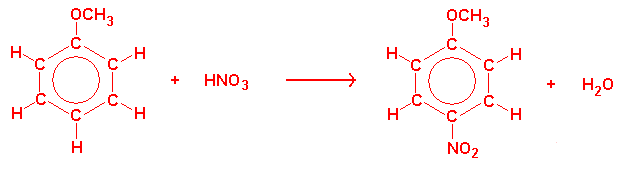
In this reaction we see the formation of a number of coloured products. We can predict the product using the technique above. Water must be produced this time, so the group that substitutes into the benzene ring must be the nitro group, -NO2. The product shown below is 4-nitromethoxybenzene (again other isomers are possible):
|
|
You will see the brown gas, nitrogen dioxide, produced by the decomposition of the concentrated nitric acid towards the end of the video. If the temperature is allowed to rise or more concentrated nitric acid is used (we used 50% acid and 50% water) then multiple substitution may occur. This means that two or three nitro groups may be introduced onto the benzene ring. This is quite a popular exam question.
The nitronium ion, NO2+, is the electrophile.
In all of these reactions we see a significant increase in reactivity of the methoxybenzene compared to methylbenzene or benzene itself. This is due to the increased electron density from the delocalised oxygen lone pair. You might like to compare the conditions required for the same reactions with benzene.