ISSR CLASSES
Checkpoint Science
iGCSE Chemistry
iGCSE Physics
iGCSE Coordinated Science
A-Level Chemistry
PRACTICALS
Practicals Home
Practicals A-Z
Study Plan for Practical Work
|
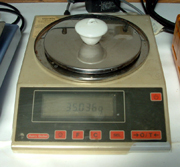
The most common weighing instrument used in the "A" Level laboratory is a top pan balance. It is a precision piece of equipment that will usually weigh either to the nearest 0.01 gram or 0.001 gram. You may use the data linking capacity of most modern balances, and link it to a PC. However, usually you will be simply using the balance for direct weighing. |
|
|
|
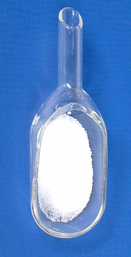
We can either weigh directly into a reaction container, like a beaker, or use a weighing boat. Weighing boats are available as a disposable plastic version or a reusable glass variety. Always ensure that the balance is clean before use. A common cry from students is that the balance was dirty before they used it - this is not an acceptable excuse!! If you find the balance with a spillage, you must first clean this up. Otherwise it may affect your weighing, and any chemical spillage may be causing damage to a very expensive piece of equipment. A dirty laboratory is a dangerous place. The balance pan can be removed from the balance and small spillages brushed into a sink and washed away. If it is a major spillage ask a teacher or technician to help. Spillages will lose you credit in an assessment. |
If you are doing quantitative work (were the quantity is important) always weigh directly into the vessel you will be using, or weigh by difference. If you weigh out exactly 1.000 g of solid into a weighing boat and then transfer it to a beaker to make up a standard solution, some of the solid is likely to stick to the weighing boat. You will actually have less than 1.000 g in the beaker. Either weigh directly into a tared beaker, or weigh the weighing boat before and after the transfer. The difference in mass will be the actual mass transferred.
|
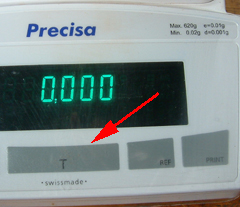
You should only need to use two buttons on your balance. The on/off switch turns it on and off! The tare button (often marked T, as in the photograph) sets the balance to zero. If weighing into a beaker, ensure that the beaker is clean and dry. Don't assume that all beakers weigh the same - they don't, even if they look the same. |
|
A simple rule - try not to spill anything, but if you do clean it up immediately (you will have to restart your weighing). Spillages will cost you credit during practical assessment. You are less likely to spill anything if you bring the bottle containing the chemical close to the mouth of the beaker or weighing boat. Try to have a steady hand. If you are trying to weigh out an exact weight it helps to gently tap the spatula against a finger nail over the weighing boat.
The phrase "weigh out accurately about....." sometimes causes confusion. This simply means that it is important that we know the exact mass, but the mass weighed does not need to be a particular value. Don't waste time trying to get an exact mass if it isn't necessary. If asked to weigh out accurately about 0.1 g, then anything from about 0.095 to 0.105 g will be fine. There will be no extra credit for getting 0.100 g.
|
The balance will usually settle to a value fairly quickly. However, the reading can quite easily fluctuate through draughts and people leaning against the bench. Electronic noise can also cause the reading to change. If the value has settled for about ten seconds, don't worry if it changes just as you are about to remove the weighed item. Avoid moving the balance as it will need to be accurately levelled. |
|
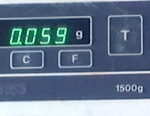
A small note book is very helpful. Always write down the weighed mass at the balance. This limits errors in recording. Use the correct number of significant figures for the accuracy of the balance - in other words include any final zeros. So 0.100 g should not be written as 0.1 g.