ISSR CLASSES
Checkpoint Science
iGCSE Chemistry
iGCSE Physics
iGCSE Coordinated Science
A-Level Chemistry
PRACTICALS
Practicals Home
Practicals A-Z
Study Plan for Practical Work
|
|
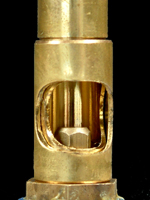
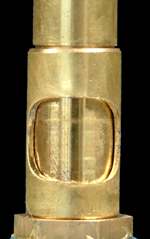
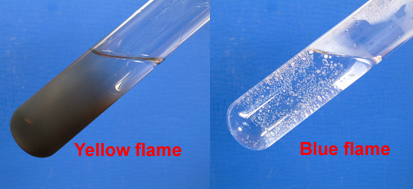
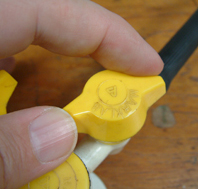
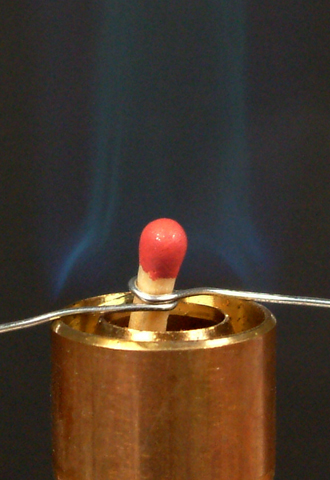
The Bunsen burner is the most common heating device used in the "A" level laboratory. Natural gas is used as the fuel. This is mixed with the air, which enters through the air hole, and is ignited at the top of the barrel. A number of things can be use to light the Bunsen. You may have a piezo-electric lighter, like those used for gas cookers, a flint lighter or some matches. I find that a cheap cigarette lighter is very handy for the practical chemist. Close the air hole before you attempt to light the burner, otherwise you will find it difficult to light. When the Bunsen lights, as the air is restricted, the gas burns with a yellow, luminous flame. When not heating, always leave the Bunsen with the air hole closed. The luminous flame is much easier to see, particularly in a bright laboratory. Accidents have occurred when students have been unable to see the blue that results when the air hole is open. |
|
|
|
|
|
|
|
Blue flame with air hole open |
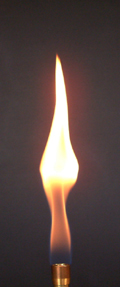
Yellow flame with air hole closed |
|||
|
It is the presence of unburnt carbon in the flame from partial combustion that gives it its yellow colour. This same effect can be seen in a badly adjusted gas fire, something which all students should be aware of. A yellow flame and signs of black carbon are signs of incomplete combustion which are accompanied by the colourless, odourless gas carbon monoxide. This gas, produced by badly maintained boilers and fires, has killed a number of students in lodgings. Don't worry in the laboratory - there is not enough produced to cause any damage. Never heat with a yellow flame. It is very dirty and will leave deposits of carbon on the glassware. If the blue flame is too hot, you can adjust the Bunsen burner at the gas tap. |
|
|
|
|
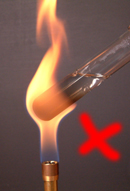
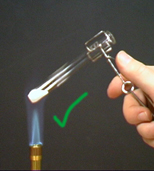
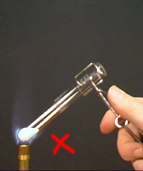
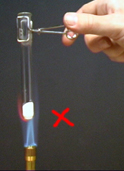
You will often be asked to heat a small quantity of solid or liquid in a test tube or boiling tube. Always use test tube holders to hold the test tube. Students often try to use tongs or fingers - this is hazardous! Tongs are not designed to hold test tubes and fingers burn. We need to heat the solid or liquid, not the test tube or holders. Consequently, you should attach the test tube holders just below the rim of the test tube and angle the test tube so that only the contents are directly heated. Remember that the inner blue cone of the Bunsen is not hot, so the test tube should be a little above this point. You can see this in the photograph.
|
|
|
|
When heating liquids we need to be aware of bumping. This is the sudden production of vapour at the base of the liquid which propels boiling liquid, with some force, out of the open end of the tube. Always ensure that there is no-one in front of your boiling tube, and remember that people do move around! If you need to boil a liquid, use a boiling tube which is wider and less prone to bumping than a test tube. Always keep the boiling tube moving by gentle shaking. When it starts to boil remove the tube from the Bunsen flame until the boiling subsides. If you need to keep the contents boiling you can briefly return the boiling tube to the flame. You will see this in the video.
You will find that the use of an electric heating mantle may offer more control than a Bunsen burner. It is also safer as there is no naked flame so less chance of the contents catching fire.