ISSR CLASSES
Checkpoint Science
iGCSE Chemistry
iGCSE Physics
iGCSE Coordinated Science
A-Level Chemistry
PRACTICALS
Practicals Home
Practicals A-Z
Study Plan for Practical Work
|
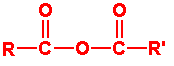
This is an acid derivative, that is a molecule made from a carboxylic acid. They have the general formula RCOOCOR' (where R and R' stand for any group of carbon and hydrogen atoms). |
|
|
It may help to remember the formula if you think what the name means. Anhydride means without water, and an acid anhydride is made by the removal of a molecule of water from two molecules of carboxylic acid. |
|
|
|
They are very reactive compounds, and are consequently not found in Nature. Ethanoic anhydride (old name, acetic anhydride) is the commonly available acid anhydride in the lab. |
Acid anhydrides are named after the parent carboxylic acid followed by the word anhydride, giving a name of the type alkanoic anhydride. Be careful not to add up all the carbon atoms present, there will be two carbon chains in the molecule.
Example
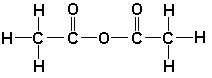
The structural formula is CH3COOCOCH3
The name is ethanoic anhydride.
|
|
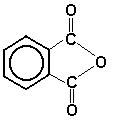
We don't meet many acid anhydrides at "A" level. Ethanoic anhydride is the usual example. I've included this second example for completeness as it is quite a well-known one. Its systematic name is benzene-1,2-dicarboxylic anhydride. It is better known as phthalic anhydride. |
Acid anhydrides are reactive molecules which react in a similar, but slightly less vigorous, way to acyl chlorides. The C=O carbon atoms are quite positive as they are attached to two electronegative oxygen atoms. This means that acid anhydrides attract nucleophiles. The reactions of acid anhydrides produce the same organic products as the reactions with acyl chlorides. However, rather than losing hydrogen chloride in the reaction, we lose the parent carboxylic acid:

Acid anhydrides react with water to produce two molecules of the parent carboxylic acid. This is just the reverse of the reaction used to produce them:
|
CH3COOCOCH3 + H2O ⇒ 2CH3COOH |
Most "A" level students meet ethanoic anhydride in the preparation of aspirin:
|
|