ISSR CLASSES
Checkpoint Science
iGCSE Chemistry
iGCSE Physics
iGCSE Coordinated Science
A-Level Chemistry
PRACTICALS
Practicals Home
Practicals A-Z
Study Plan for Practical Work
|
In order to balance a chemical equation you must start with the correct formulae for the materials involved. Remember, that whilst most elements go around as single atoms (eg Cu, Mg, C), there are some important ones which are diatomic. This means that they go around in pairs (eg O2, N2, H2, F2, Cl2, Br2, I2). |
|
You will often be asked to include state symbols in your equation. These usually don't cause any problems (apart from students forgetting to put them in!). Solids are given the symbol (s), liquids (l), gases (g) and aqueous solutions (aq). Aqueous solutions are materials dissolved in water, like common salt solution.
Balancing an equation is simply a matter of ensuring that there is exactly the same number and type of atoms on both sides of the chemical equation. Chemistry isn't magic, and does not allow atoms to disappear or appear out of nowhere. In a chemical reaction we just rearrange the atoms that we have. The equation is balanced by sticking numbers in front of the formulae symbols until the numbers of atoms are the same on both sides. For example, in the equation to make water from hydrogen and oxygen:
|
H2(g) + O2(g) ⇒ H2O(l) |
|
|
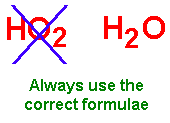
This equation is not balanced as there are two oxygen atoms on the left and only one on the right. This often leads to the first mistake that students make with balancing equations, that is to change the formulae. In this case they change the water into H2O2. The equation is now balanced, but H2O2 is not water, it is hydrogen peroxide - a completely different chemical. Pure hydrogen peroxide causes most organic materials to burst into flames on contact. Definitely not to be confused with water! This reaction produces water, so we must stick with the formula for water. Similarly, if you know how to work out ionic formulae, it's a bit daft to do so and then change them into an incorrect formula that just happens to fit. NEVER CHANGE THE FORMULAE! |
|
The equation shows the number of moles of each chemical involved in the reaction. We change these until the equation is balanced. When you place a number in front of a formula it applies to everything which follows it. In the above case we start by having 2 moles of water as this will have two moles of oxygen atoms, as on the left:
|
H2(g) + O2(g) ⇒ 2H2O(l) |
However, two moles of water contains four moles of hydrogen atoms, so we must also have two moles of hydrogen molecules on the left to balance the equation. The final balanced equation is:
|
2H2(g) + O2(g) ⇒ 2H2O(l) Balanced |
We could also have used fractions in order to balance it, as half a mole of oxygen molecules contains a mole of oxygen atoms (½ × 2 = 1):
|
H2(g) + ½O2(g) ⇒ H2O(l) Balanced |
Try to balance the following equations. The answers are hidden underneath in the grey areas, and can be revealed by clicking and dragging with your mouse. If you've used any halves you'll have to double up your answer to compare it with mine.
Cu(s) + O2(g) ⇒ CuO(s)
2Cu(s) + O2(g) ⇒ 2CuO(s)
N2(g) + H2(g) ® NH3(g)
N2(g) + 3H2(g) ® 2NH3(g)
Ca(NO3)2.4H2O(s) ⇒ CaO(s) + NO2(g) + O2(g) + H2O(g)
2Ca(NO3)2.4H2O(s) ⇒ 2CaO(s) + 4NO2(g) + O2(g) + 8H2O(g)
And for those of you that like a challenge:
P2I4 + P4 + H2O ⇒ PH4I + H3PO4
10P2I4+ 13P4 + 128H2O ⇒ 40PH4I + 32H3PO4
If you are balancing an ionic equation, it must not only balance in atoms, but also in charge. For example, the following equation looks balanced, with one iodine atom and two chlorine atoms on both sides:
|
Cl2(aq) + I-(aq) ⇒ ½I2(aq) + 2Cl-(aq) |
but if you check the charges you will see that there is a two minus charge on the right hand side, but only a one minus charge on the left hand side. Doubling up the iodine gives a two minus charge on both sides, so the equation is now correctly balanced in atoms and charge:
|
Cl2(aq) + 2I-(aq) ⇒ I2(aq) + 2Cl-(aq) Balanced |
All equations can be balanced by inspection, that is just guessing the numbers until it all adds up correctly. It can sometimes save a bit of time and effort to know that in a redox reaction the oxidation number always rises and falls by the same amount. For example:
|
Cr2O72-(aq) + H+(aq) + I-(aq) ⇒ Cr3+(aq) + I2(aq) + H2O(l) |
We can balance the chromium (2 on each side), the oxygen (7 on each side) and the hydrogen (14 on each side) by inspection:
|
Cr2O72-(aq) + 14H+(aq) + I-(aq) ⇒ 2Cr3+(aq) + I2(aq) + 7H2O(l) |
but the charge does not balance (11+ on the left, but 6+ on the right). It helps to know that the chromium has changed in oxidation number from +6 to +3, that is it has dropped by three. The Iodine has risen by one (from -1 to 0). This means that there must be three iodine to every one chromium, so with two chromium atoms we must have six iodine atoms. Putting this in finishes off the balancing:
|
Cr2O72-(aq) + 14H+(aq) + 6I-(aq) ⇒ 2Cr3+(aq) + 3I2(aq) + 7H2O(l) Balanced |
There is now a 6+ charge on both sides and the equation balances.